

On Nov. 4, the Canada-Newfoundland and Labrador Offshore Energy Regulator (C-NLOER) announced 10 successful bids from the 16 parcels offered in the 2026 Call for Bids, with work commitments totaling C$260.6 million. It was the largest number of successful bids in a single round since 2000, and a striking reversal for a basin long defined by what it failed to deliver.
After years without a single bid, Shell, Equinor, and OilCo are injecting real capital behind offshore Newfoundland and Labrador exploration.
The Orphan Basin, where years of dry holes iced the industry’s enthusiasm, is back on explorers’ radar.
Years of Frustration, Followed by a Fresh Start
Forty-seven years ago, the Blue H-28 well penetrated deepwater Orphan Basin, offshore Newfoundland and Labrador. At 1,486 m, it broke the water depth record for the time and encountered reservoir-quality sands in the Lower Cretaceous, yet it came up water-wet (Koning 2015). Since then, fewer than a dozen wells have been drilled within a 200 km radius of Blue H-28, with nothing to show but dusty drill bits and unfilled potential.
Recent high-impact wells, such as Ephesus F-94, Persephone C-54, and Pelles A-71, turned out to be high-impact heartbreaks for operators BP, Hess, Chevron, Exxon, and CNOOC, and especially for local stakeholders, the C-NLOER, and OilCo (the Oil and Gas Corporation of Newfoundland and Labrador).
Beyond the subsurface uncertainty, the Province had been plagued by government hesitancy on energy policy and an emissions cap that was viewed unfavorably by industry. The combination of subsurface and above-ground issues resulted in years of unsuccessful Calls for Bids.
The landscape began to shift in November of 2025 with Ottawa’s commitment to scrap the emissions cap, and a year later, the 2026 Call for Bids launched a defining new chapter that could change the basin's trajectory forever.
From Bidless to Breakthrough
The years of quiet bid rounds ended during the 2026 Call for Bids which closed as one of the most successful ever. Shell followed its October agreement to acquire a 30% stake in Equinor’s Bay du Nord project by doubling down. It led the round with six successful bids on parcels covering about 15,400 km² and C$210.6 million in commitments and partnered with Equinor on two more for C$30 million. OilCo even joined the party by picking up two prospective parcels of its own, committing C$20 million, and planning to bring in partners through farm-downs while keeping a 10% back-in at sanction.
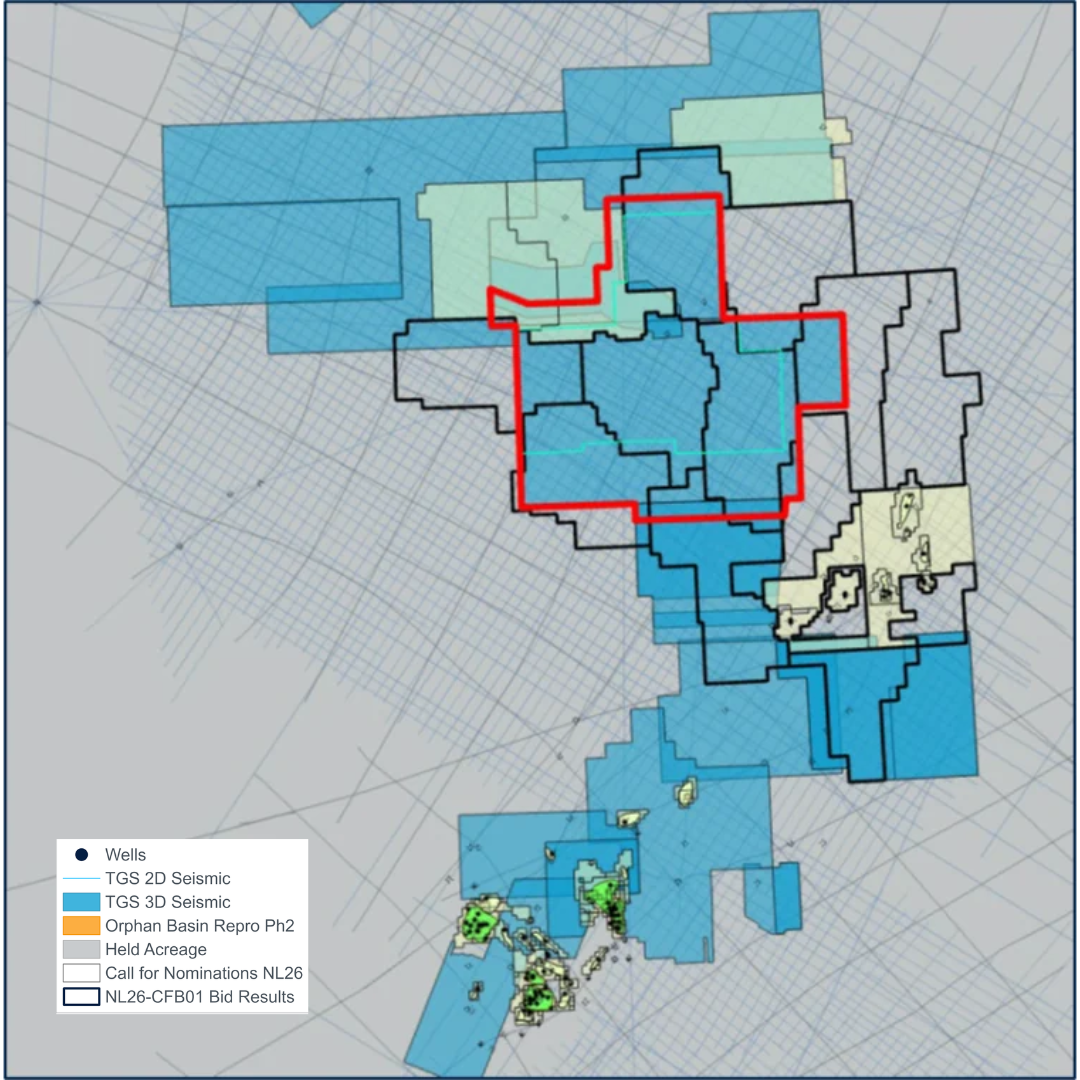
Government support helped set the stage, with the province's 2026 budget committing C$90 million over three years to an Offshore Exploration Fund. But the breakthrough was years in the making: through rounds that drew no bids, OilCo and TGS kept making the technical case for the province, using TGS' extensive multi-client data library and new depth reprocessing to show explorers where the opportunities lie and how to de-risk them.
A Dynamic Market Shift
The 2026 Call for Bids was not the only signal. In October, North Sea independent, Ithaca Energy, agreed to acquire Suncor’s Terra Nova and White Rose interests for US$860 million upfront. Together, the asset acquisition deal and the results of the Call for Bids show exploration and production capital moving in tandem. Shell, Equinor, and OilCo are betting on frontier acreage in Orphan Basin, while Ithaca is betting on the producing fields of the Jeanne d’Arc Basin. The shallow-water producing assets differ from deepwater frontier exploration, but the message is consistent; majors are reshaping their portfolios, and new entrants are making their move. Meanwhile an iceberg-sized gap in offshore Newfoundland and Labrador exploration is finally closing.
Making Sense of the Subsurface
TGS has been building toward this moment since 1998, when it acquired the first multi-client seismic survey offshore Eastern Canada. A phased 2D program with PGS, now part of TGS, and a subsequent 3D campaign launched in 2015 that now covers about 84,000 km² from the Grand Banks to the Labrador Sea set the foundation for the latest round of exploration.
The offshore territory hosts prospective structural and stratigraphic targets, however, unraveling seismic amplitude responses at clastic reservoirs remains a consistent challenge. Successful fields such as Bay du Nord and dry holes such as Great Barasway F-66 and Lona O-55 show similar responses at the targets and distinguishing a discovery from a dud takes better velocity models, sharper imaging, and seismic attributes that de-risk reservoir quality and source rock maturity. With drilling now back on the horizon, operators need high-quality seismic to prospect and calibrate.
As with any multi-client seismic investment, timing is everything and TGS’ Orphan3D PSDM Phase 2 reprocessing, could not be timed better. The project is upgrading about 13,300 km² of 3D seismic data in the heart of the parcels bid in the latest round, with final migrated volumes scheduled for delivery in the third quarter of 2027.
The new processing program will use TGS’ Dynamic Matching Full Waveform Inversion (DM FWI) velocity model building workflow and least-squares Kirchhoff migration to improve amplitude fidelity and illuminate complex rift structures, fault planes, and robust depositional fairways to help operators make data-driven decisions.
With Bay du Nord’s final regulatory approval announced, and the new wave of licensees preparing work programs, the latest momentum is a reminder that in a cyclical industry, the tides can turn in a matter of moments. And in NL’s case, preparation and persistence are paying off.
Dive Deeper:
-
Explore East Coast Canada : https://hubs.ly/Q04G0Y4M0
-
Prospectivity Insights from Simultaneous Velocity and Reflectivity Inversion, Offshore Newfoundland and Labrador, Canada: https://hubs.ly/Q04G0Yt50
-
Petroleum System of Offshore Labrador, Canada Call for Bids 2025: https://hubs.ly/Q04G0YTP0
-
Unraveling Newfoundlands Emerging Energy Plays : https://hubs.ly/Q04G0Z6C0
References:
-
Reference: Koning, T. (2015, February 1). Going deeper: Blue H-28 was a whale of a tale. AAPG Explorer. https://www.aapg.org/news-and-media/explorer/going-deeper-blue-h-28-was-a-whale-of-a-tale/