Indonesia
Indonesia is believed to hold significant undiscovered oil and gas reserves. With an active licensing round process, numerous frontier basins and near-field opportunities, it remains one of the most attractive countries for offshore exploration. Major energy companies continue to invest, reinforcing Indonesia's status as a key area for hydrocarbon exploration.
Why Indonesia?
Indonesia's Ministry of Energy and Mineral Resources has announced the promotion of 75 oil and gas blocks for joint study and regular tender between 2025 and 2027. A significant portion of these areas is already supported by high-quality multi-client seismic data from TGS, covering North Sumatra, Natuna, Kutei Basin, Makassar Strait, East Java, West Berau and South Papua.
Indonesia hosts 128 sedimentary basins, 68 of which remain undrilled, offering substantial frontier exploration potential. Even in mature provinces like the Kutei Basin, recent major discoveries highlight what advanced seismic imaging and modern exploration technologies can deliver.
Indonesia at Scale with 2Dcubed
TGS is building a growing portfolio of 2Dcubed projects across Indonesia, delivering basin-scale seismic datasets that enable faster, more confident screening across the archipelago.
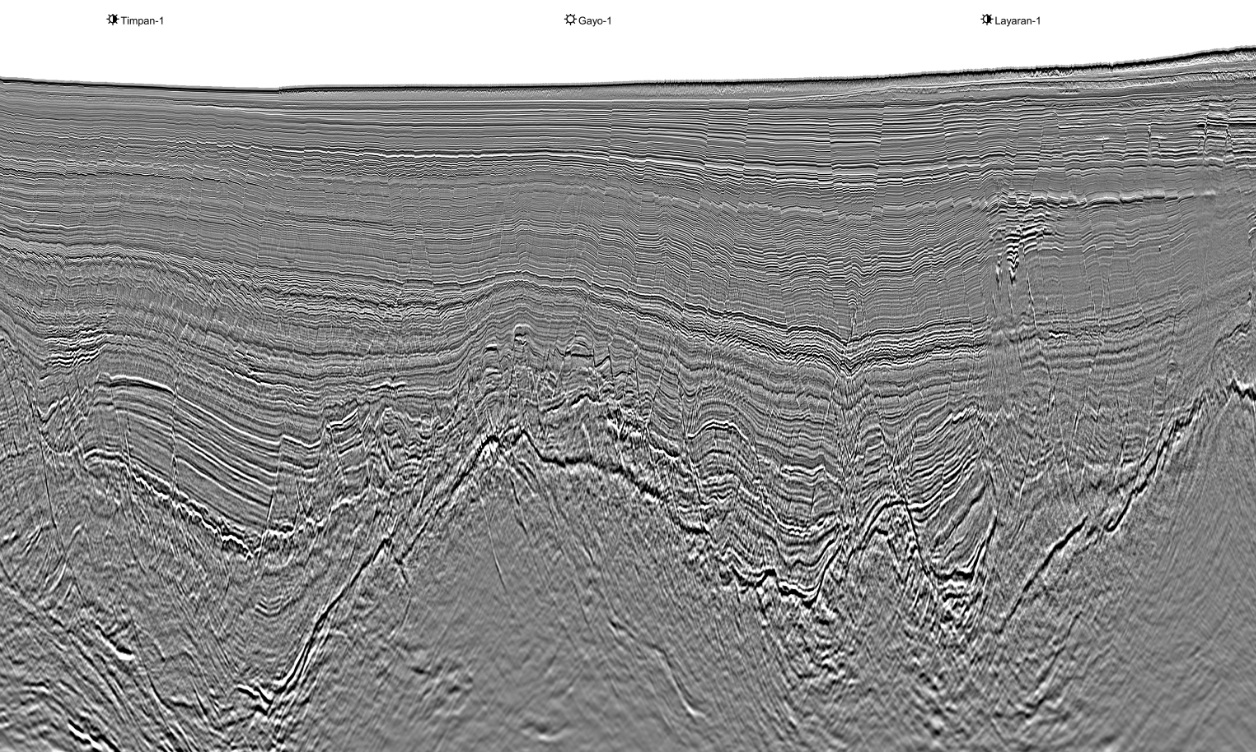
Coverage spans key exploration areas including the Kutei Basin, East Java Basin, West Berau Basin and South Papua. These datasets work together as a consistent regional framework, helping explorers evaluate prospectivity across both mature and frontier basins. Using TGS' proprietary 2Dcubed technology, large volumes of legacy 2D data are integrated into a single, conformable regional product, enabling rapid interpretation and consistent evaluation across licensing blocks.
High-Quality Multi-Sensor GeoStreamer 3D Seismic Data
TGS has expanded its portfolio of multi-sensor GeoStreamer multi-client 3D seismic datasets across Indonesia. Key projects include the North Madura 3D, West Timor 3D, West Abadi 3D, North Sumatra 3D and South Makassar 3D surveys.
GeoStreamer technology improves seismic resolution and structural clarity while delivering deeper subsurface penetration. This is achieved by combining hydrophone and particle velocity sensors, enabling effective receiver deghosting via wavefield separation.
Advanced acquisition and imaging workflows, including Seismic Wavefield Imaging, capture broadband data from shallow to deep targets. By leveraging the full frequency spectrum, these datasets provide sharper imaging, improved stratigraphic resolution and more reliable inputs for AVO/AVA analysis.
Multi-Client Reprocessing
TGS extracts value from legacy datasets through advanced multi-client reprocessing programs across Indonesia, giving explorers cost-effective subsurface insights. A key example is the Natuna Basin 2D Regional Reprocessing Project, covering the West Natuna Basin and East Natuna Basin, separated by the Natuna Arch. The West Natuna Basin is a proven hydrocarbon province with a complex tectonic history, while the East Natuna Basin, though less explored, hosts known discoveries but presents significant imaging challenges due to complex geology and thick shallow carbonate sequences.
The project integrates data from more than 20 wells and applies modern processing technologies including broadband reprocessing, advanced demultiple techniques, amplitude-preserving denoise, Pre-Stack Depth Migration and Full Waveform Inversion.
East Java and Kutei Facies Map Browser (FMB)
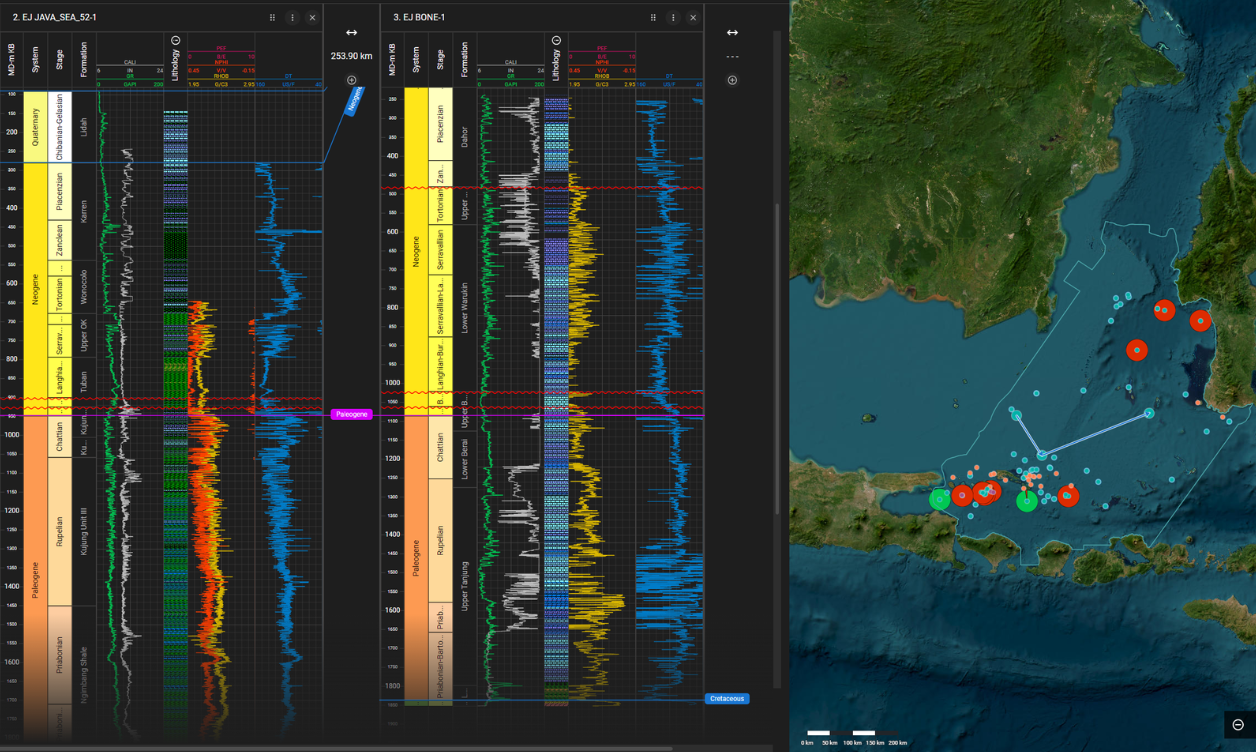
The regional seismic dataset, combined with well data from the region, supports high-quality interpretation products. The study includes detailed well interpretation covering sequence, chronostratigraphic and lithostratigraphic picks, as well as gross depositional environment and facies analysis.
Inputs include cutting descriptions, core, well correlations, seismic facies and biostratigraphic reports. Particular attention was paid to lithological interpretation, specifically the variation and gradation within the dominant carbonates, feeding into a broader depositional model built on the region's existing hydrocarbon story.
Regional gross depositional environment maps delineate the geological evolution and sedimentary history of the region, providing petroleum system insights at key intervals with additional applications for carbon capture and storage. All well and map datasets are delivered via an easy-to-use desktop browser for querying and visualizing interpreted wells, facies maps and the stratigraphic framework.
Oil and Gas Exploration Hotspots in Asia Pacific: Data-driven Opportunities in Malaysia, Indonesia, and India
10/21/2022 - Upstream exploration is making a strong comeback across Asia Pacific with recent successes sparking renewed industry enthusiasm...
Depositional Framework and New Stratigraphic Insights in the Kutei Basin
10/21/2022 - The Kutei Basin in East Kalimantan is Indonesia’s most prolific hydrocarbon province. Recent discoveries such as Geng North-1, Gehem, and Gendalo-Gandang, now part of the Northern Hub development, underscore both its productivity and remaining potential...
Tracking Eocene Source Kitchens
Source rocks, migration pathways and trapping structures are now revealed with broadband GeoStreamer data and offer both new exploration plays and near-field opportunities...
Speak to a Specialist
Interested in a product demo or trial? Let us know your needs and we’ll connect you to the right person or team.
Book a Data Viewing
Want to see the latest seismic data solutions and imaging technologies in your region of interest or for the next license round? Book a data viewing with one of our experts.
Discuss Your Seismic Data Needs
Every need is different and we'd like the opportunity to discuss yours further. Speak to one of our data or geoscience experts to customize seismic solutions specific to your requirements.