


First Published: First Break - July 2026, by Guanghui Huang, Jaime Ramos-Martínez, Carlos Calderón-Macías, Faqi Liu, and Dan Whitmore (TGS)
Abstract
The expanding application of full-waveform inversion (FWI) beyond structural imaging requires a clearer understanding of which subsurface properties can be robustly recovered from seismic data. Extending FWI from acoustic to elastic formulations enables estimation of parameters critical for quantitative reservoir characterisation. We present a multiparameter elastic FWI (MP-EFWI) workflow for the joint inversion of P-wave velocity (vp ), S-wave velocity (vs ), and density (ρ). As the first-order system of elastodynamic equation is not self-adjoint, an extra adjoint equation is required for computing the correct sensitivity kernels. Our implementation uses the same elastic wave equation for both forward and backward propagation, connected by a compliance tensor for evaluating accurate gradients, avoiding the need for an explicit adjoint solver, thereby improving computational efficiency.
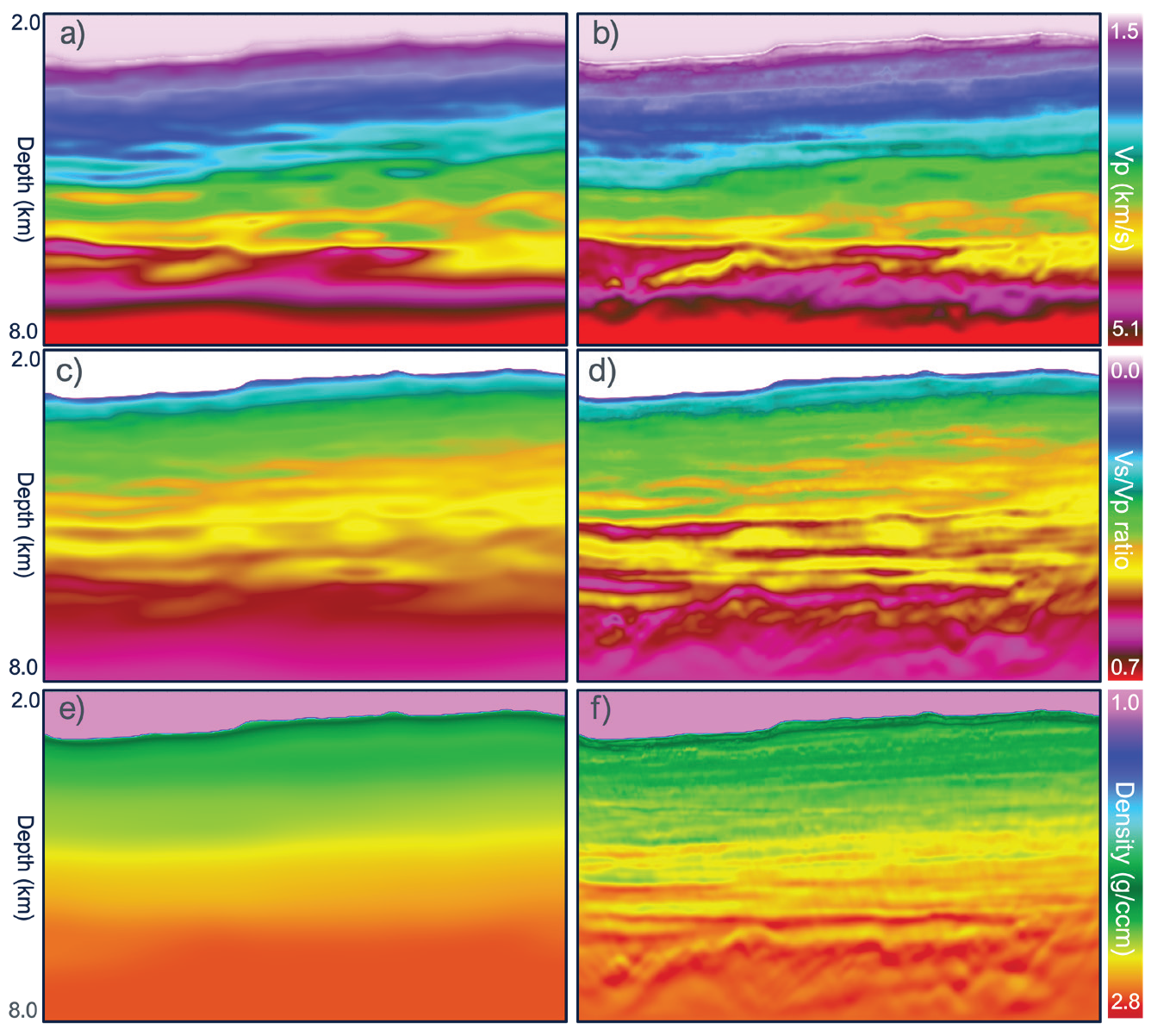
Field data MP-EFWI example in deep-water offshore Brazil. Initial a) vp , c) vs / vp and e) density models. Inverted b) vp , d) vs / vp and e) density models.
The study focuses on pressure-only data typical of marine acquisition. The approach is demonstrated using a synthetic deep-water scenario, where results show that updates in vs and density are mainly driven by local contrasts, supporting quantitative interpretation. The workflow is then applied to field data offshore Brazil. Inverted models are validated against welllog data and by comparing angle-dependent amplitude responses derived from the inversion with those observed in Kirchhoff prestack depth migration gathers. The results demonstrate that MP-EFWI applied to pressure-only data can provide valuable information to support reservoir characterisation.
Read the full article here.