

2026 has turned into one of the most consequential exploration years in over a decade. On the heels of BP's play-opening discovery at Bumerangue in the Santos Basin, announcements have followed from the equatorial margins of Brazil and Suriname, West Africa's Tano Basin and Angola's Lower Congo Basin.
National oil companies are expanding their exploration footprint across the globe, from frontier oil plays on the Atlantic margin to gas discoveries reshaping import strategies in Cairo and Bogotá. Exploration teams are managing the risk of that activity with multi-client seismic data.
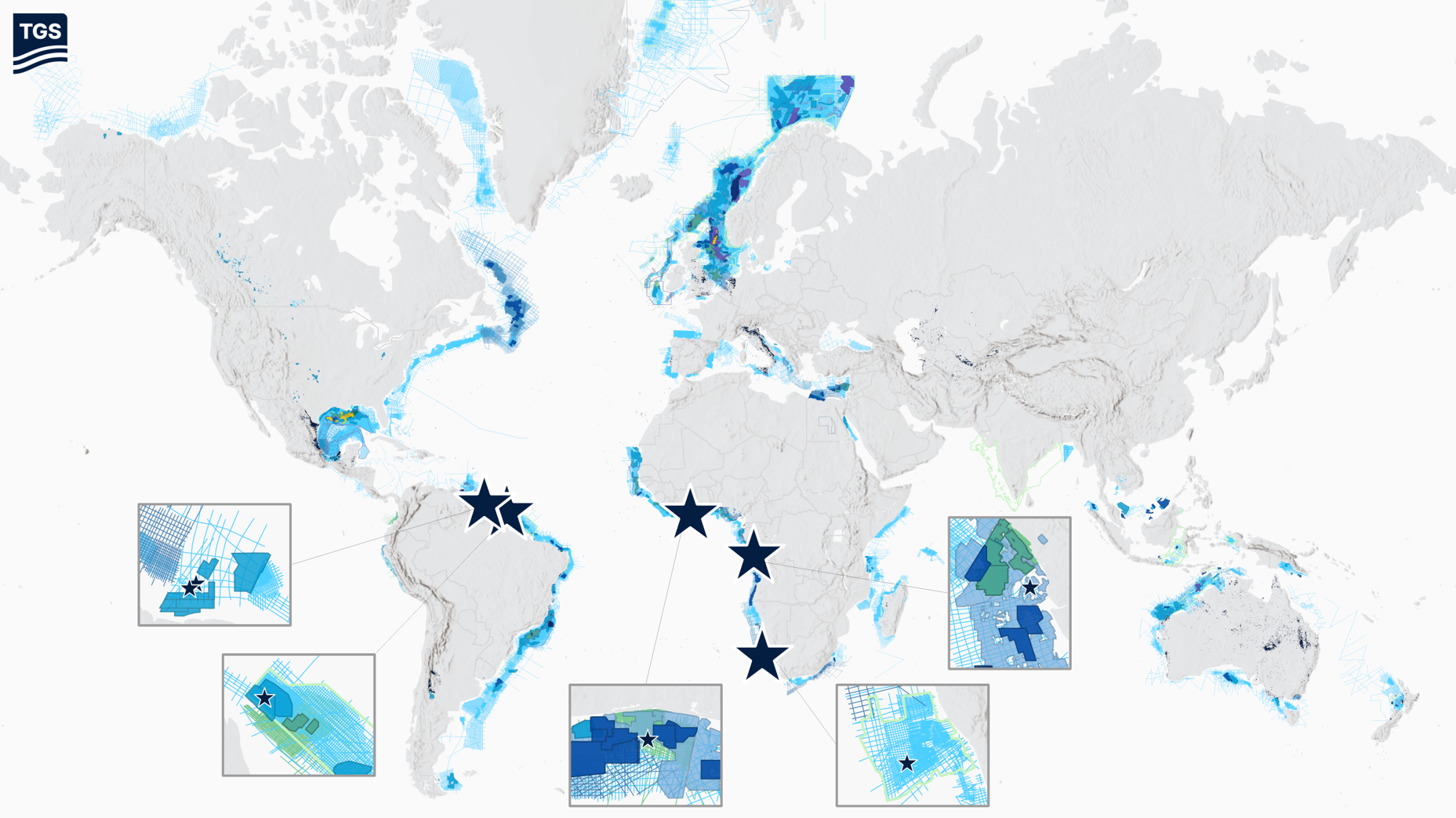
To see how much that risk reduction shaped this year's discoveries, we checked ten of the most talked about ones, including Petrobras, Eni, Murphy, Azule, Petronas and Santos, against TGS's global 2D and 3D multi-client seismic library. Here's what they had in common:
- Stratigraphic and structural plays from Miocene to Cretaceous across four continents highlight the importance of high-quality seismic data.
- Both frontier and infrastructure-led exploration rely on decades of seismic vintages in TGS’ library, with most of the wells studied located within the TGS data library footprint.
Over the coming weeks, this Special Edition Discovery Series will take a closer look at the data behind some of 2026’s exploration stories, starting with Suriname and continuing with a new discovery deep dive each week.
Suriname Basin has emerged as one of the Atlantic margin's most prolific frontier plays, with Petronas confirming eight successful wells and over one billion barrels of recoverable oil equivalent in Block 52 alone. The Caiman-1 well, announced as a discovery in July 2026, drilled to 5,065m in 90m of water at the shelf edge, intersected multiple oil-bearing Cretaceous sandstone intervals in Campanian-age turbidite-channel systems, a shallower, oil-charged counterpart to the gas-bearing Sloanea and Swartzia Aspasia Complex discoveries roughly 8km to the east. Together, these results confirm a working, multi-phase (oil and gas) petroleum system operating across a range of water depths on the same structural trend.
This raises a speculative but testable question for Suriname's nearshore and shallow-shelf acreage: the blocks tested by 24 legacy wells drilled between 1982 and 2019. That historical record shows a consistently active hydrocarbon system: the large majority of wells recorded oil or gas shows, with show rates as high as 100% in several campaigns, yet none progressed to commercial discovery. Critically, none of those 24 wells' recorded objectives targeted Campanian-age intervals specifically; the historical drilling concentrated on Paleocene, Albian, Cenomanian, Santonian, and Maastrichtian objectives, leaving the Campanian turbidite-channel play now validated at Caiman-1 largely untested updip of the shelf edge.
We speculate that if Campanian turbidite-channel sands extend landward from Block 52's shelf-edge position into the shallower shelf blocks, via updip pinch-out, stratigraphic thinning, or lateral facies change into shoreface or deltaic equivalents, the nearshore acreage may host a bypassed, age-specific play window rather than an exhausted one. The persistent oil and gas shows across the legacy well set would then represent evidence of an actively charging system whose reservoir objective was never directly tested.
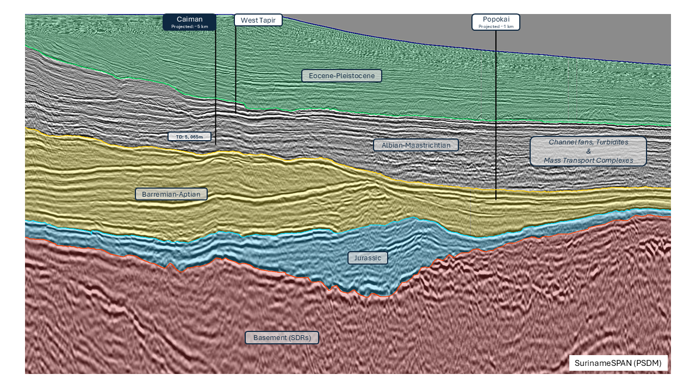
Caiman-1 is just downdip of TGS' Suriname 3D Phases I, II and V, and near a Suriname SPAN 2D line. Using these complementary datasets together provides regional context for both the shallow and deep-water plays. Recent drilling success and Staatsolie's open-door policy emphasize Suriname's position as one of the most exploration-friendly countries in South America. Operators are recognizing this potential: the open-door offering has attracted a total of five bids, two of which are in the shallow-water sectors of Suriname.
Join us next week to explore more of the data behind the discoveries and all of today’s exploration opportunities. Visit TGS seismic data library or contact us to schedule a data showing.
Go Deeper:
-
Brazil’s Seismic Solution to Modern Frontier Exploration: https://hubs.ly/Q04znhfN0
-
PAMA 3D: Quality Data, Faster Decisions, Stronger Bids: https://hubs.ly/Q04znj-s0
-
De-risking Exploration in West African Basins: https://hubs.ly/Q04znmTd0
-
Egypt’s West Mediterranean Sea – A Global Exploration Hotspot: https://hubs.ly/Q04znnz30