

On Oct. 7, Brazil’s oil regulator, ANP, awarded 56 blocks across two bidding sessions, collecting roughly $650 million (USD) in signature bonuses.
The 2026 OPP and OPC rounds made one thing clear: Petrobras believes the answer to Brazil’s salt basin exploration challenge lies in the outboard stratigraphic frontier. Its recent investment in blocks at the edge of the salt canopy in Campos Basin showcase the strength of that conviction. The Sixth Cycle of Permanent Concession Offer or OPC6, raised a record $600 million (USD) in signature bonuses, almost all of it from Petrobras, underscoring a major shift in the type of exploration play being pursued in the basin.
Salt Basins: Fresh Momentum or Fading Play?
On the surface, the Fourth Cycle of the Open Acreage of Production Sharing (OPP4) round was encouraging. A record seven blocks were awarded, up from five in the previous cycle, expanding production-sharing acreage by 58% to 39,200 km². Even so, the pre-salt play needs fresh momentum or it will plateau and decline within the next decade. Standout bidders PRIO, Equinor, Galp, CNOOC/Sinopec, and Petrobras hope to fill that need through continued exploration in traditional pre-salt carbonates and post salt turbidites. Although the prospects may be more modest than in the past, creaming curves suggest there is still more room to run.
The record round and globally diverse roster of winners does not, however, imply competition. In the pre-salt, 19 companies qualified, but only six of them bid, and all the awarded blocks had only a single bidder. Six blocks did not receive bids, including Larimar and Turmalina, which have been repeatedly discarded.
Notable absentees Exxon, Chevron, Shell, and BP chose capital discipline. Caution among the super-majors has lingered around the pre-salt polygon for years now, but the latest rounds offer a behind-the-scenes look at how exploration companies are investing and how they view the remaining resource potential of the maturing salt basins. PRIO made a splash in Campos, picking up Hematita and Magnetita and expanding its territory around Frade, Wahoo, and Albacora. Equinor continued to employ its high-risk, high-reward strategy in Santos with the Rubi block and, partnering with Galp, will explore the prospective Rodocrosita block situated between Sagitário and Lapa. Finally, the Chinese national oil companies (NOCs) remained consistent in their interest in Brazil’s offshore jewels, returning for Jade a year after committing to the Ametista block.
Conviction in Campos
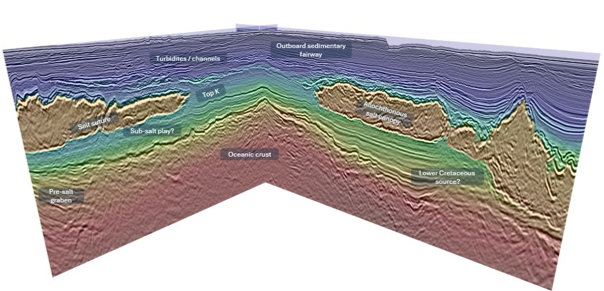
Petrobras’ 12 OPC blocks in ultra-deep Campos Basin will play a significant role going forward because of their position outboard of the salt canopy. Frontier exploration of deepwater stratigraphic plays in Brazil’s Equatorial Margin and Pelotas Basins has now cascaded into Campos, where the Retiro Salt formation abruptly terminates and clastic depositional fairways can be interpreted in 2D and 3D seismic.
The deepwater blocks lie in 3,200–3,400 m of water and are the conjugate margin analog to Angola’s Block 48, where Total drilled Ondjaba-1, outside of the salt canopy, in 3,626 m of water in 2021. Although the Lower Congo Basin well was unsuccessful, the Total and QE consortium still bid on the Campos Basin frontier play, creating rare competition for Petrobras. Its offer, however, fell well short of the State Company’s winning bid, again showing Petrobras’ firm belief in the outboard and a commitment to explore in deeper water than ever. It’s deepest well to date was drilled in 3,000 m of water in the Sergipe-Alagoas Basin, so the new Campos blocks will push Petrobras up to 400 m beyond its previous drilling record, the equivalent height of Pão de Açúcar (Sugarloaf Mountain).
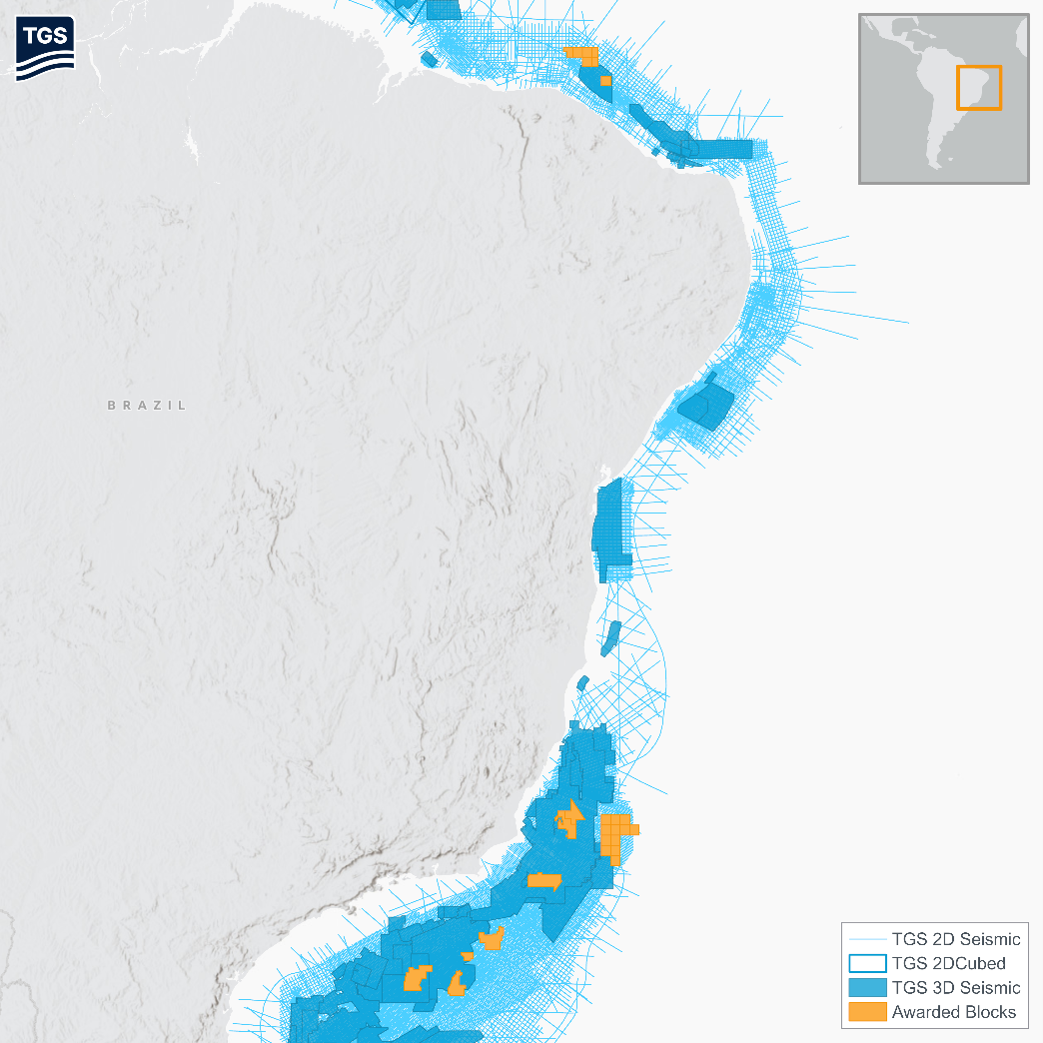
TGS’ Campos Deepwater 3D images the western edge of this trend, confirming robust sedimentary fairways at the salt and crustal boundary and revealing both Cenozoic and Mesozoic reservoir targets charged by early-to-mid Cretaceous source rocks. As the work commitment proceeds, additional seismic surveys will be acquired to de-risk the frontier play and the high-impact wells that follow could have a ripple effect on both sides of the Atlantic.
In short, Petrobras is following through on its promise to expand its exploration initiative beyond the pre-salt play. Following “Morpho-fever,” it also won every available block in the Ceará Basin within the Equatorial Margin, further solidifying its geographic diversification strategy while at the same time targeting uncharted water depths in Campos that could open plays along the entire margin.
What comes next for South America’s largest oil-producing country? A new chapter of offshore exploration, as Brazil boldly pushes into deeper waters and investigates new plays across its offshore basins.
For companies evaluating opportunities in this area, high-quality regional subsurface data will be key to understanding the broader geological context. TGS’ extensive multi-client library enables these plays to be extrapolated across the entire basin, identifying new opportunities throughout the rift, sag and post-salt stratigraphy. Visit TGS seismic data library or contact us to schedule a data showing.
Dive Deeper:
-
Brazil Pre-Salt Basins Geology: https://hubs.ly/Q04BxQfq0
-
Brazil’s Seismic Solution to Modern Frontier Exploration: https://hubs.ly/Q04BxR8k0
-
Multi-Client Seismic Facilitates Production Increase in the Campos Basin, Brazil: https://hubs.ly/Q04BxS2S0
-
A Case Study from Santos Basin: https://hubs.ly/Q04BxS-n0
