


The Location
Location
East Breaks area, Gulf of America
Survey
Amendment West 1 (field test)
Survey Year
Field data acquired in 2025
Date Processed
Dec. 2025 to Feb. 2026
Data acquisition (in this study)
Sparse Ultra-Long Offset OBN
Survey Size
Test Area: ~130 km²
Water depth
~900 m – 1200 m

The Challenge
Balancing Efficiency and Data Quality
Exploration-scale OBN surveys require high source productivity to cover large areas efficiently while delivering data quality suitable for imaging and inversion. Conventional multi-source acquisition often creates a trade-off, where adding more sources leads to a more difficult source separation problem. Apparition encoded shooting is optimal in this respect, because of its strong-on-strong, weak-on-weak property. In addition, it enhances Signal-to-Noise Ratio (SNR) at ultra-low frequencies because of the small encoding delays between shots in an Apparition encoded salvo.
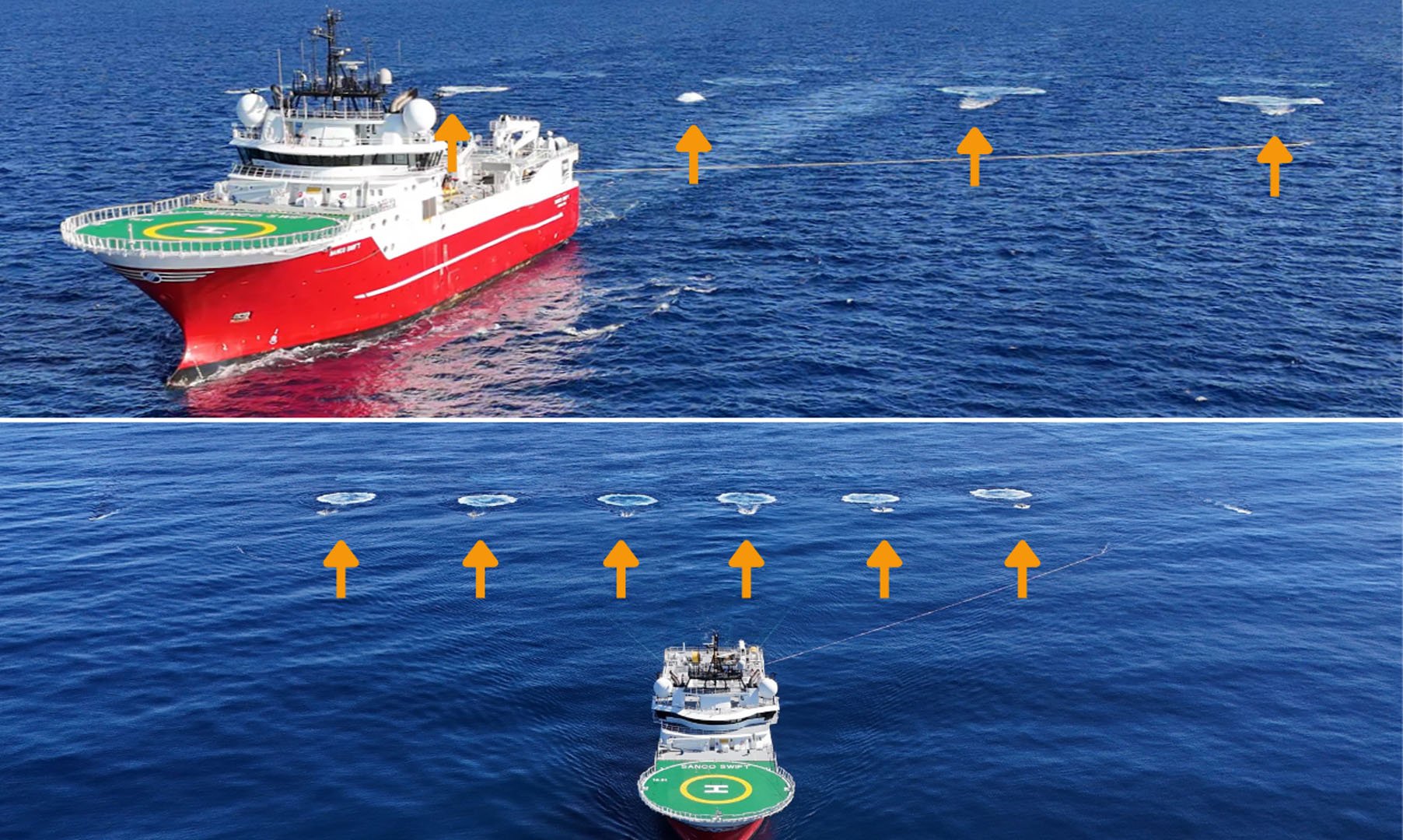
Amendment West 1 used a dual-vessel quad-source Gemini configuration with dithered shooting. The challenge was to test whether a more efficient, single-vessel hexa-source encoded configuration maintains signal fidelity and whether the expected uplift in ultra-low frequency SNR can be demonstrated.
Recovering Ultra-Low Frequencies
Ultra-low frequency signal content below 2 Hz is essential for reliable Full Waveform Inversion (FWI). A low SNR in this band may hinder convergence of FWI toward an accurate long-wavelength velocity model. In complex geological settings, these frequencies are critical for stabilizing the inversion process and resolving reliable subsurface properties.
In dithered multi-source acquisition, weaker low-frequency arrivals can also be masked by stronger overlapping events, which further limits recoverability after deblending. The test aimed to validate whether deterministic Apparition encoding could improve signal coherence and separation in this band, enhancing SNR and making low-frequency energy more usable for inversion.
Demonstrating Imaging Value
Improved data-domain quality must translate into measurable gains in imaging and model building. The Amendment West 1 test needed to show that decoded hexa-source data not only appeared cleaner but could match production data in Reverse-Time Migration (RTM) imaging and deliver more accurate ultra-low-frequency elastic FWI updates from the same sparse receiver geometry.


The Solution
Test Design
- Gemini X (Gemini EFS + Apparition)
- Single vessel, hexa-tow configuration
- Sparse ZXPLRe node patch
Pre-Processing Solution(s)
VMB and Imaging
- Elastic Dynamic Matching FWI
- 12Hz RTM Imaging
Data Management
- Vessel-to-shore LEO satellite data transfer
- Imaging AnyWare® processing platform
In the main production survey, TGS deployed an integrated acquisition-to-imaging approach that combined ZXPLRe ocean bottom nodes, Gemini Enhanced Frequency Source technology, quad-source dithered shooting scheme with deblending-based energy separation, vessel-to-shore LEO satellite data transfer and Elastic Dynamic Matching FWI (E-DMFWI) model building. The Amendment West 1 field trial tested a hexa-source encoded geometry against the quad-source dithered production baseline.
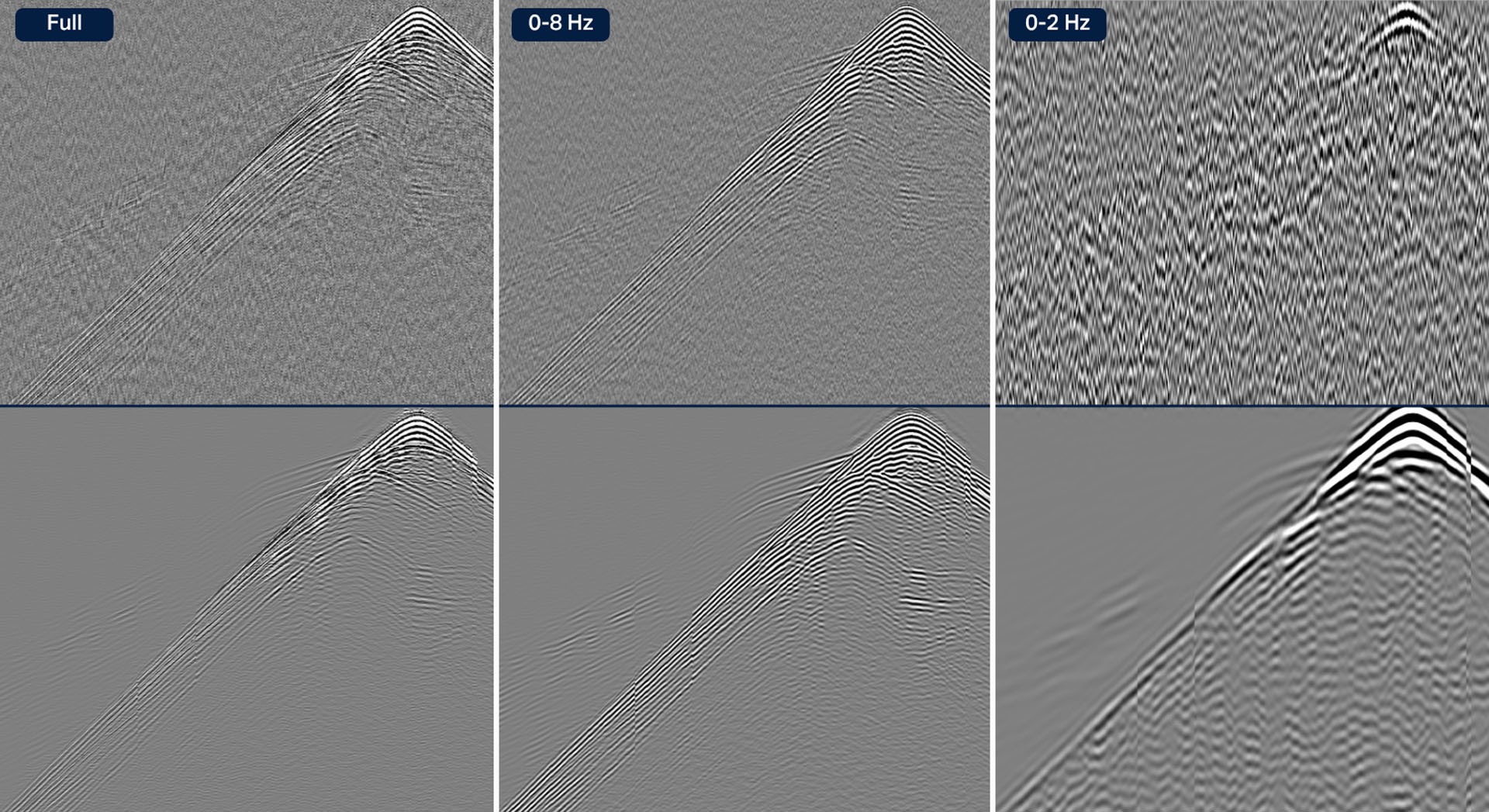
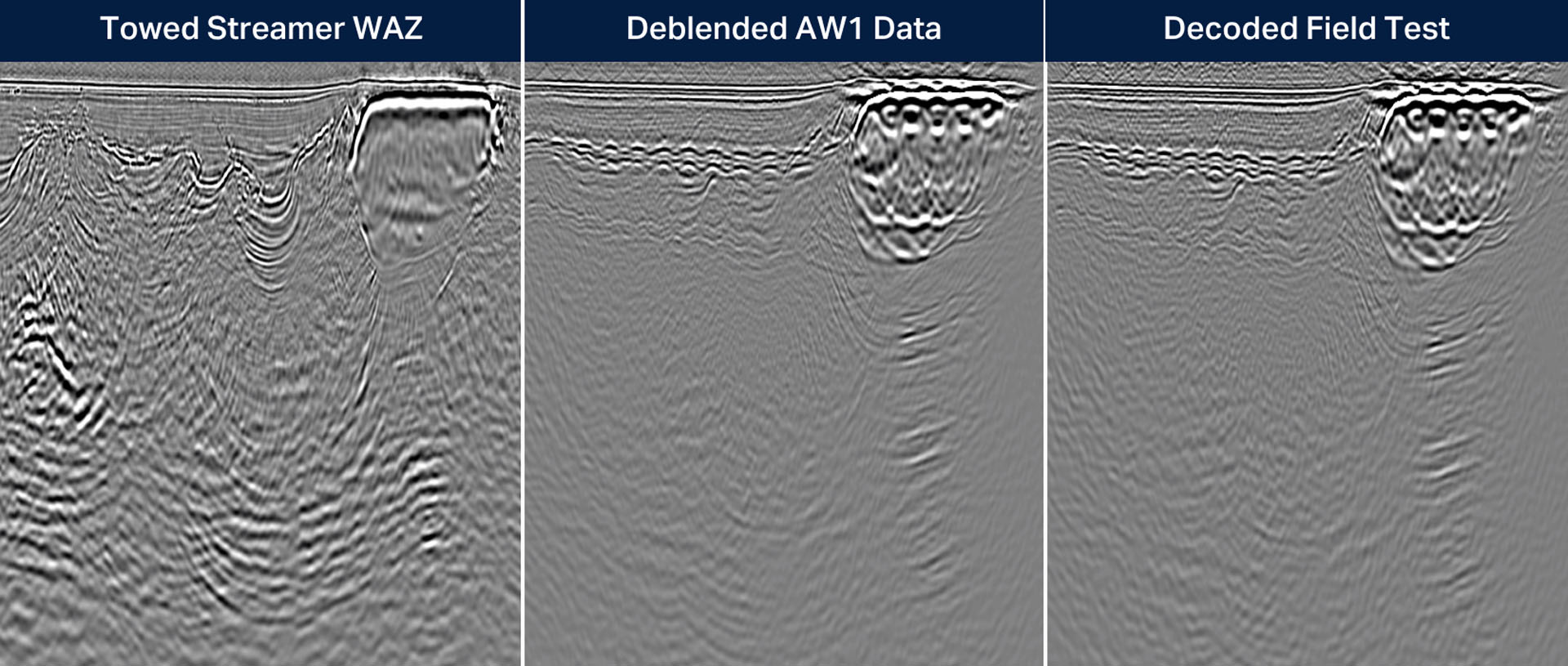
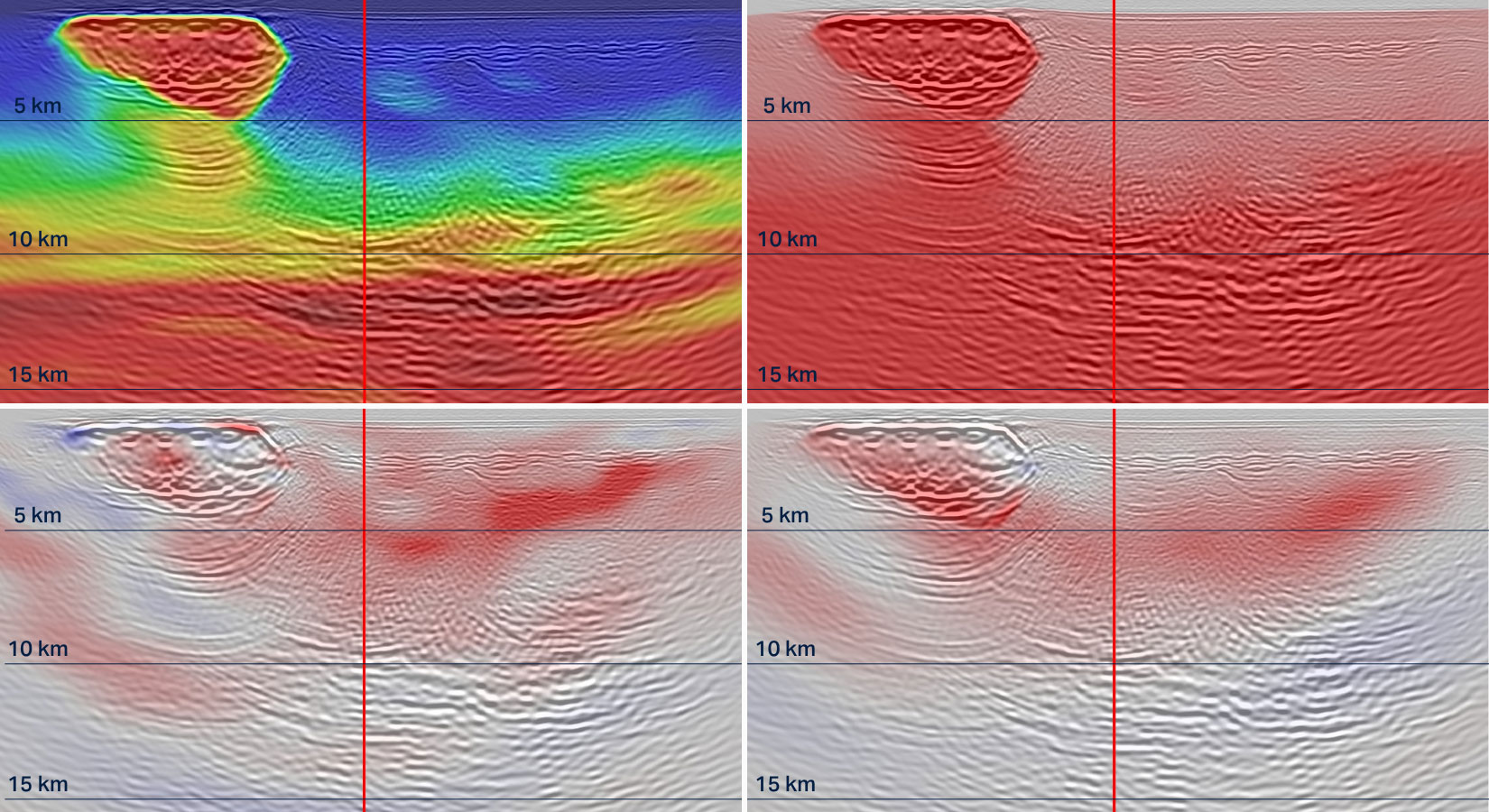
Decoded test data and deblended production data were compared through gathers in different frequency bands, RTM imaging and ultra-low frequency E-DMFWI updates. This end-to-end workflow linked broadband data, efficient acquisition, responsive delivery logistics and inversion-based model building within a single TGS solution.

The Results
Better SNR for the Ultra-Low Frequencies
The combined use of Gemini EFS and Apparition decoding delivered significantly improved SNR across all frequencies compared to deblended production data. Building on the enhanced low-frequency output of the Gemini source, Apparition encoding/decoding led to unprecedented SNR at ultra-low frequencies.
The improvement was most pronounced below 2 Hz, confirming better recoverability of inversion-critical low-frequency information.
RTM Imaging On Par
RTM imaging showed no material difference between decoded hexa-source data and deblended quad-source production data, confirming that increased source density did not degrade imaging quality.
Consistent acquisition quality from ZXPLRe nodes and stable source behavior from Gemini EFS contributed to reliable input data, while efficient data delivery through LEO satellite transfer supported timely processing and rapid quality assessment of results in the image domain.
Improved FWI Updates
Ultra-low frequency FWI updates derived from decoded Apparition data more closely approximated the target velocity perturbation than those from deblended production data. Enhanced low-frequency input from Gemini EFS and improved SNR on Apparition decoded data provided higher-quality inversion input. These gains were fully leveraged through E-DMFWI, which enabled improved long-wavelength velocity updates critical for complex subsurface imaging.
Conclusion
The Amendment West 1 field test demonstrated an integrated workflow combining ZXPLRe nodes, Gemini Enhanced Frequency Source technology and Apparition deterministic encoding, delivering a step change in low-frequency data quality while improving acquisition efficiency. Enhancements in signal strength, coherence and recoverability directly address the traditional trade-off between productivity and data fidelity. These gains are preserved through decoding and fully exploited in imaging workflows using E-DMFWI, resulting in more stable inversion and improved long-wavelength velocity models.
Looking ahead, this integrated TGS workflow provides a scalable path for future exploration surveys that demand both efficiency and high-fidelity data. By combining advanced acquisition, near-real-time data delivery through LEO satellite transfer and inversion-driven imaging, the approach supports faster decision-making and enables more confident evaluation of complex subsurface targets in increasingly challenging environments.
Commercial Impact

End-to-End Acquisition-to-Imaging Workflow
Combines ZXPLRe nodes, Gemini EFS, Apparition decoding, E-DMFWI, and LEO satellite transfer into a unified solution from acquisition through inversion.
Higher Efficiency Without Data Quality Trade-Off
Improved Inversion and Imaging Confidence
Faster Data Access and Decision Making