

OSLO, Norway (21 April 2026) — Emerging foundation technologies could reshape global offshore wind deployment and the role of floating wind, according to a new TGS | 4C analysis on deep-water offshore wind presented at WindEurope 2026 in Madrid.
The latest research re-examines the global offshore wind resource, considering advances in deep-water fixed-bottom and hybrid technologies, challenging long-held assumptions about the dominance of floating wind in deeper waters.
Historically, waters beyond 50 meters have been considered the domain of floating offshore wind. However, new technologies are extending the viable range of fixed-bottom and hybrid solutions, opening a broader portion of the global seabed to alternative development approaches.
A global map included in the analysis highlights the distribution of suitable offshore wind resources between 60 and 400 meters of water depth, illustrating how significant portions of the world’s wind potential could be accessible to multiple competing technologies.
The findings show that while more than 70% of global wind resources have traditionally been associated with floating wind, this share could fall significantly as hybrid and deep-water fixed-bottom technologies mature. In this evolving landscape, floating wind is expected to remain an important part of the offshore mix, but no longer the default solution for deeper waters.
The analysis also highlights a concentration of deep-water opportunities in a small number of markets. The United States, Canada and Russia together account for more than half of the world’s suitable seabed, while among more active markets, the UK stands out as a key area for development.
As a result, competition between foundation technologies is expected to increase, with cost, deployability and site conditions becoming key differentiators in project selection. Hybrid solutions, in particular, are emerging as a potential bridge between traditional fixed-bottom and floating technologies, offering cost advantages in certain depth ranges.
“The industry is entering a phase where technology choice will play a much larger role in determining project viability,” said Jordan May, Senior Analyst at TGS | 4C and author of the analysis.
“As new solutions extend into deeper waters, developers will need to reassess assumptions around site suitability and long-term deployment strategies,” added Ivar Slengesol, Managing Director and VP at TGS | 4C.
TGS | 4C will be at WindEurope 2026 in Madrid to discuss these findings with industry stakeholders. Analysts will be available to explore how deep-water technologies, resource distribution and project economics are shaping the next phase of offshore wind development.
The team can be found at Hall 9, Stand C40, where attendees can meet with experts and discuss the implications of evolving offshore wind technologies.
The analysis forms part of TGS | 4C’s broader offshore wind intelligence offering, combining market data, technical insight and project-level analysis to support decision-making across global energy markets.
TGS | 4C provides intelligence reports on offshore energy trends via its 4C Intelligence platform. As a division of TGS, a leading energy data and intelligence provider, it also offers consultancy services for offshore projects, including offshore wind, subsea power cables, telecommunications, pipelines, and geospatial IT and GIS services. For further information, please visit www.tgs4.com (https://www.tgs4.com/).
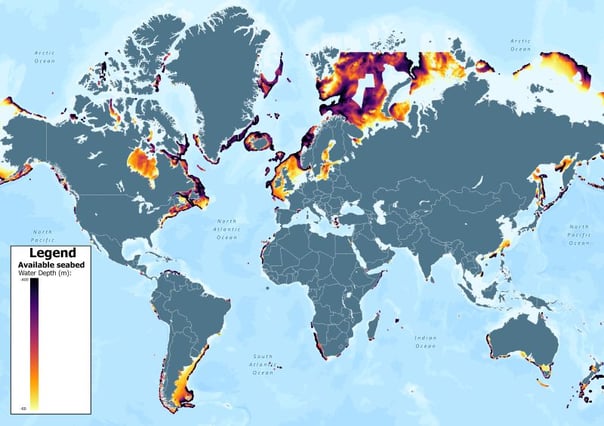
Image: Global offshore wind resource between 60–400m water depth, highlighting areas suitable for floating, fixed-bottom and hybrid technologies. TGS | 4C analysis.
About TGS
TGS provides advanced data and intelligence to companies active in the energy sector. With leading-edge technology and solutions spanning the entire energy value chain, TGS offers a comprehensive range of insights to help clients make better decisions. Our broad range of products and advanced data technologies, coupled with a global, extensive and diverse energy data library, make TGS a trusted partner in supporting the exploration and production of energy resources worldwide. For further information, please visit www.tgs.com (https://www.tgs.com/).
For media inquiries, contact:
Bård Stenberg
IR & Business Intelligence
investor@tgs.com