

Fewer wells, stronger economics, and shifting inventory are redefining how oil and gas assets are valued
The U.S. oil and gas industry is drilling roughly 30% fewer wells than it was five years ago, yet nationwide production is relatively steady, and modern wells are generating stronger economics than before. That shift is fundamentally reshaping how assets are evaluated and helps explain why the M&A market looks very different today. The oil and gas M&A market has undergone a major shift from a record-setting consolidation wave in 2022–2023 to a more selective, technically driven deal environment in 2025–2026. What’s driving this evolution isn’t just commodity cycles or geopolitics, but a fundamental change in how operators define and extract value from inventory. Buyers remain active, but alignment on valuation has become increasingly difficult as operators reassess inventory quality, development potential, and infrastructure constraints.
TGS data highlights a clear and accelerating trend: a ~30% decline in approved permits and new wells, alongside a ~20% increase in average lateral lengths and a ~12% rise in proppant intensity across key U.S. basins over the past five years (Figure 1). These advancements in drilling and completion design have materially improved well economics, quietly reshaping the M&A landscape. Locations once considered sub-economic are now viable, changing how assets are evaluated, valued, and prioritized in today’s market.
The most important story in the data right now isn’t where activity is highest, it’s how the industry is extracting more value from fewer wells. TGS data shows that approved permits and new well counts have declined across major U.S. basins over the past five years, reflecting capital discipline, consolidation, and the depletion of the most straightforward drilling locations, but that only tells part of the story. The wells being drilled today are more efficient and productive than those drilled even a few years ago. Longer laterals distribute fixed costs, such as infrastructure, permitting, and mobilization, across a larger productive interval. At the same time, higher proppant intensity per foot increases reservoir contacts and enhances recovery. Together, these improvements lower costs per foot, improve well-level returns, and expand the range of economically viable locations.
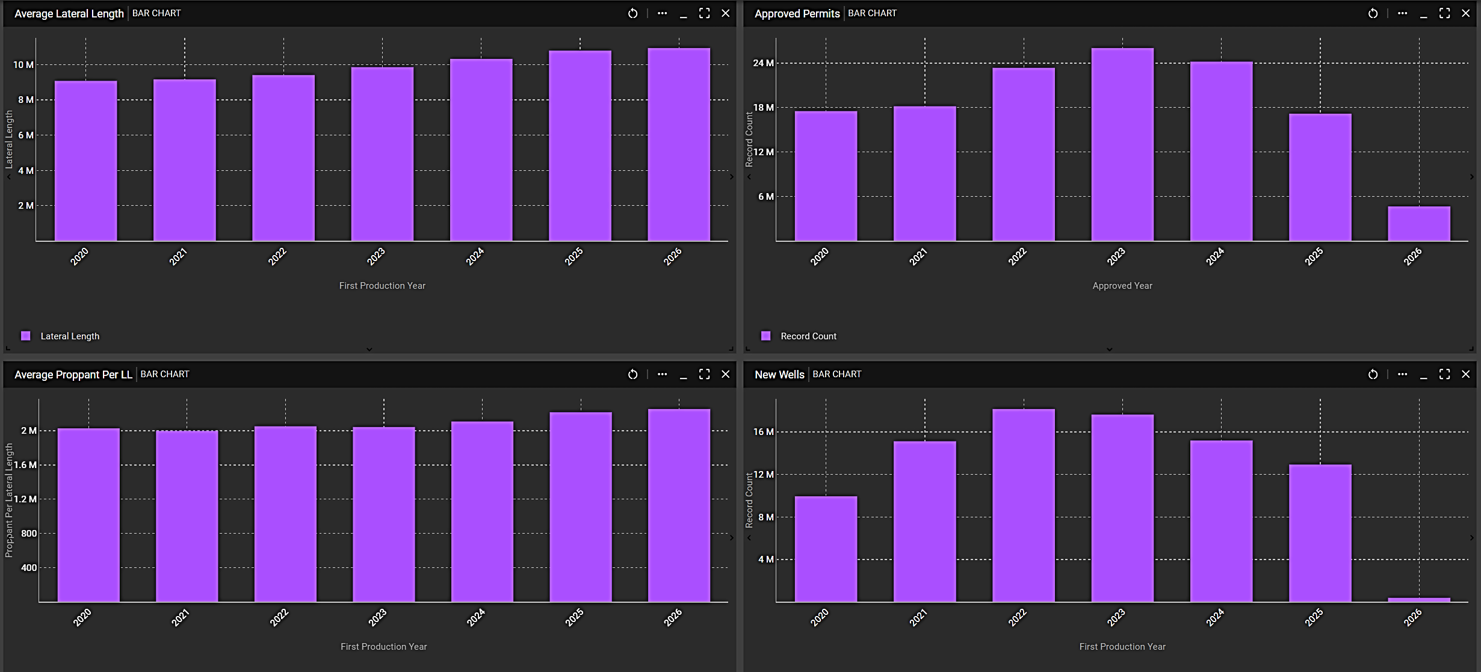
Figure 1. TGS Well Data Analytics showing permit and new well count trends (2020–2026) alongside average lateral length and proppant intensity.
Operators are not just drilling longer, they’re drilling differently. In the Midland Basin, the Dean Formation continues to deliver strong early results, with operators such as Diamondback Energy, Ovintiv, SM Energy, and Occidental Petroleum demonstrating competitive productivity from intervals between the Spraberry and Wolfcamp (Figure 2). Results across Martin, Howard, Midland, and Glasscock counties confirm that the Dean is not confined to a single core area but is emerging as a broader, repeatable play across the basin. Step-out activity is further reinforcing this trend. Private-equity-backed FireBird Energy II has extended the play north into Borden County, reporting IP rates approaching 4,000 bbl/d with ~90% oil. Notably, these results are achieved with laterals under two miles, suggesting competitive economics even outside traditional core areas and without relying on maximum lateral length.
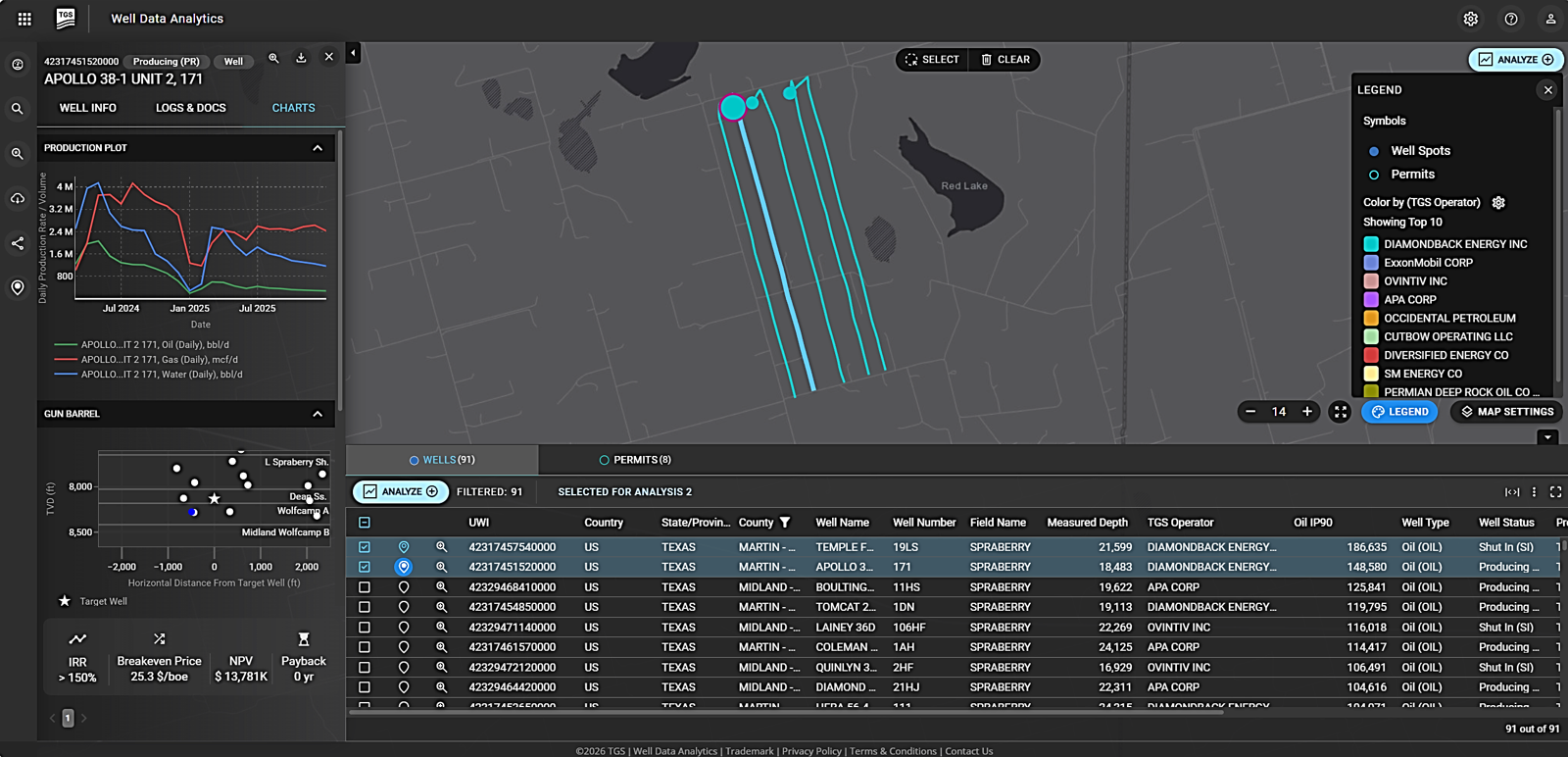
Figure 2. TGS Well Data Analytics highlighting recent Diamondback Energy Dean Formation well performance and associated economics
More broadly, next-zone testing is expanding across multiple stacked intervals, including the Dean, the oily Barnett, and the deeper Woodford, highlighting how operators are re-evaluating the full vertical potential of their acreage. At the same time, activity is extending beyond traditional targets. Blackbeard Operating’s multi-formation step-out in Crane County highlights this trend, with oil-weighted wells from shallower zones such as the Wichita Albany, McKnight, and Glorieta formations producing strong initial rates at depths of 3,000–5,000 ft, well above the 7,000–11,000 ft intervals typical of Midland and Delaware development. These results point to a broader re-evaluation of what constitutes economic inventory in the Permian system.
Alongside new bench development, mature play redevelopment is emerging as a meaningful and often underappreciated M&A driver. Refracturing and recompletion programs in established plays, such as the Williston Basin, Eagle Ford, and Marcellus are increasingly part of asset evaluation. The inventory of refrac candidates is no longer an afterthought; it is becoming a defined component of deal value.
Four Forces Driving Today’s M&A Market
Commodity & Geopolitical Price Uncertainty
Oil markets are experiencing elevated volatility driven by both price cycles and geopolitical risk. The Strait of Hormuz, through which roughly 20 million barrels per day transited in 2024, remains a critical supply chokepoint. Ongoing tensions, including the Iran conflict, have introduced sharp price swings and increased uncertainty in forward pricing assumptions. Sellers tend to anchor to high-price scenarios, while buyers’ factor in downside risk, widening the bid-ask spread and slowing deal execution.
Inventory Exhaustion in Tier-1 Basins
Core Permian acreage is largely consolidated and controlled by major operators. Buyers are increasingly pushed toward lower-tier inventory or emerging benches within existing positions. Accurately evaluating these assets, using formation-level performance, lateral benchmarks, and completion metrics is becoming critical to avoiding mispriced deals.
Strategic Shift Toward Gas & LNG
Gas and LNG-linked assets are becoming more attractive, driven by export growth, rising power demand from AI and data centers, and energy security considerations. The U.S. Energy Information Administration projects U.S. gas exports will grow ~18% in 2026 and another ~10% in 2027. In Permian, associated gas production is already approaching pipeline constraints in some areas, making infrastructure access a key driver of both development and M&A activity.
Capital Discipline & Integration
Following the 2022–2023 acquisition wave, operators are prioritizing integration, balance sheet strength, and operational optimization over aggressive expansion. Deal activity is expected to return, but in a more disciplined and selective form.
The oil and gas M&A market is not slowing, it’s recalibrating. The era of acquiring large-scale, obvious core acreage is largely behind us. What replaces it is a more technically demanding environment, where success depends on the ability to identify and quantify value in less obvious inventory: emerging formations, longer-lateral acreage, high-intensity completions, refrac opportunities, and gas-weighted assets tied to LNG infrastructure. In a market where valuation disagreement is the primary bottleneck, the ability to ground asset quality in detailed, current drilling and completion data is no longer optional, it’s a competitive advantage.
With TGS Well Data Analytics, this type of comparative analysis and benchmarking can be done in minutes. For more information on Well Data Analytics or to schedule a demo, contact us at WDPSales@tgs.com.