

Chevron applies cross-basin completion strategies to unlock higher EUR in the Williston Basin.
In Chevron’s Q1 2026 earnings call, CEO Mike Wirth highlighted how the company is applying lessons from the Permian Basin to completion design in the Williston Basin, noting that early results are encouraging. This reinforces a broader shift underway in the Bakken: completion design, not drilling inventory, is becoming the primary lever of well performance. The impact is measurable. For example, TGS Well Performance Data shows wells operated by Continental Resources yield a 52% increase in EUR per lateral foot (BOE/ft) when comparing higher- versus lower-intensity completions. While the magnitude varies by operator, the direction is consistent: higher-intensity completions increase recoverable barrels per foot and expand the frequency of top-tier wells.
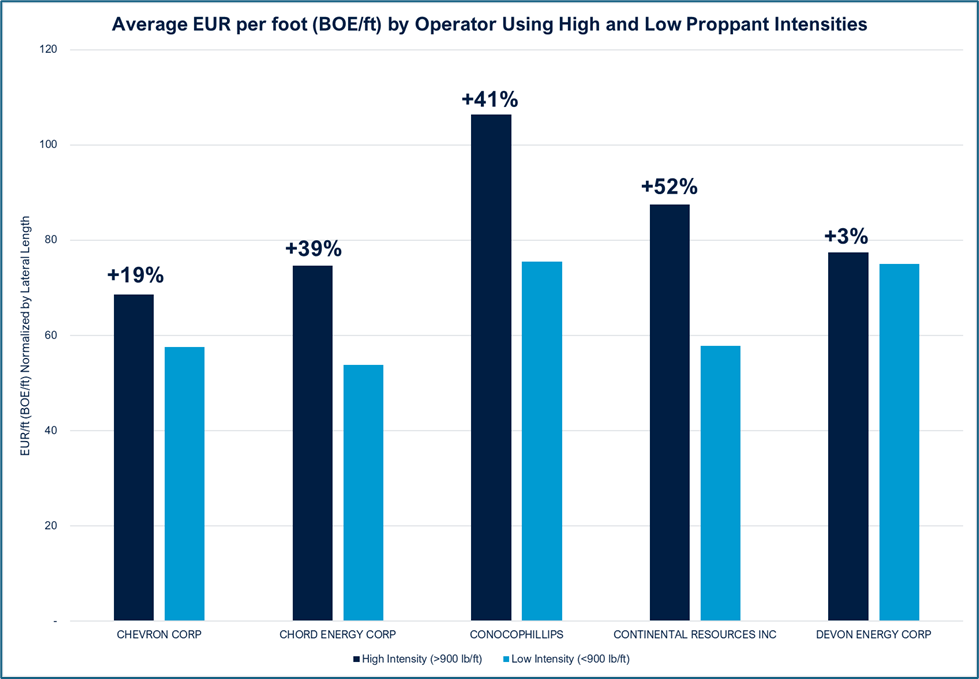
Figure 1. Average EUR per foot (BOE/ft) for 5 operators in the Bakken when using high (>900 lb/ft) and low (<900 lb/ft) proppant intensity.
Analysis of TGS Well Data Analytics, using a cutoff of 900 lb/ft of proppant, shows that wells above this threshold consistently outperform lower-intensity designs in EUR per lateral foot (BOE/ft) across leading operators (Figure 1). The uplift is significant: Chevron (+19%), Chord Energy (+39%), ConocoPhillips (+41%), Continental Resources (+52%), and Devon Energy (+3%). A closer look at development trends indicates that wells completed after 2015 are systematically shifting toward higher proppant intensities, with approximately 56% of Bakken wells exceeding 900 lb/ft from 2015–2020 and increasing to ~70% for wells completed from 2020–2026 (Figure 2). This suggests that the transition toward higher-intensity completions is already well underway across the basin.
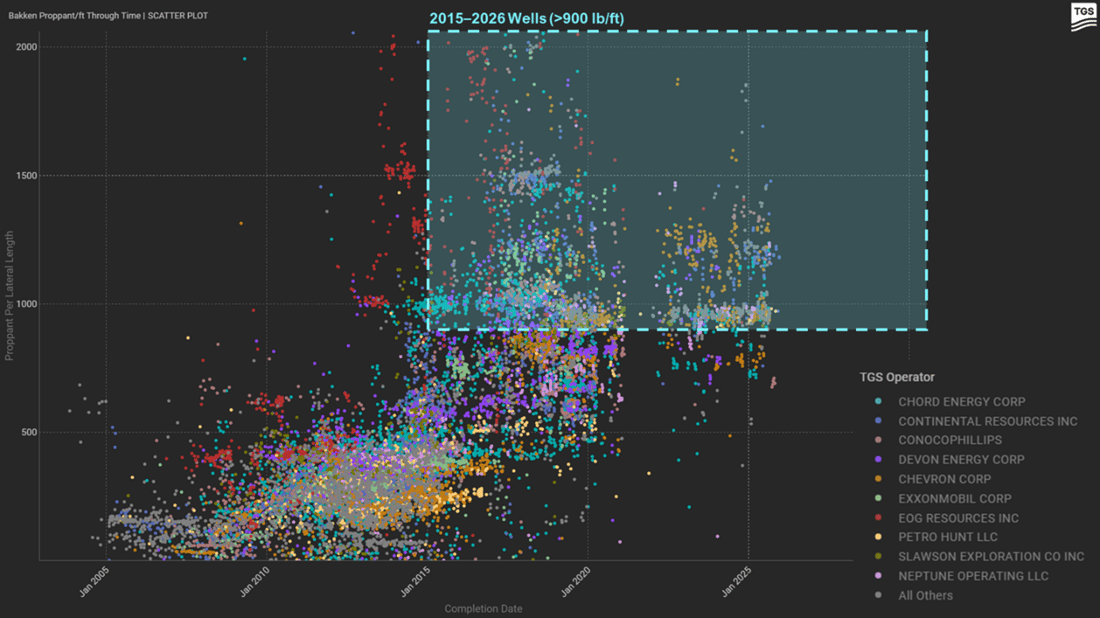
Figure 2. Proppant/ft versus Completion Date with 56% of wells between 2015-2020 and 70% of wells from 2020-2026 using >900 lb/ft intensities.
Operators are increasingly importing proven practices from other basins to capture this upside. As Mike Wirth noted, “We’re testing advanced chemicals to improve recovery in the Bakken today, things we’ve been doing in the Permian and in the DJ.” That portfolio-driven approach is reflected in cross-basin performance data. Comparing horizontal wells completed during 2015–2020 with those completed between 2020–2026 across the Permian Basin (Delaware), Denver-Julesburg Basin, and the Williston Basin shows that normalized productivity (BOE/ft/month) in the Bakken and DJ has continued to improve, while Delaware performance has flattened or modestly declined over the same period (Figure 2). The key takeaway is that technique transfer—including longer laterals, tighter stage spacing, higher proppant loading, and advanced chemistries—is helping narrow historical performance gaps across unconventional basins.
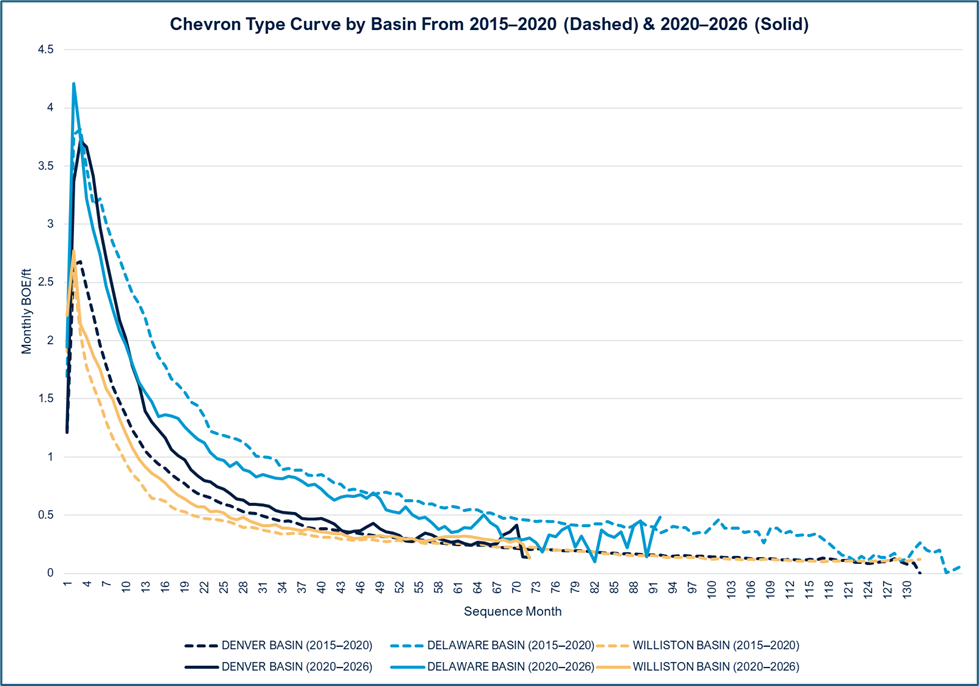
Figure 3. Type Curve by Basin for Chevron Horizontal Wells from 2015-2020 (dashed) and 2020-2026 (solid) Normalized by Lateral Length (BOE/ft/month).
For industry leaders, the implication is clear: the Bakken is now an engineering-led asset. Capital efficiency and free cash flow are increasingly determined by how wells are completed, not just where they are drilled. Operators scaling high-intensity designs (>900 lb/ft) are already capturing double-digit gains in EUR per foot (BOE/ft), while those lagging risk structurally lower recoveries. As seen previously in the Permian, the next phase of unconventional development is less about basin or landing zone selection and more about systematically deploying best-in-class completion strategies across the portfolio.
For more information about TGS Well Data Analytics or to schedule a demo, please contact us at WDPSales@tgs.com.