

OSLO, Norway (15 May 2026) — Offshore wind growth is accelerating demand for subsea cables, larger installation vessels and more resilient supply chains, creating new pressure points for project delivery through 2030 and beyond. Two new reports from TGS | 4C, a leading offshore wind intelligence provider, show that while near-term supply remains broadly manageable in some markets, longer-term constraints emerge as projects grow larger, more complex and more infrastructure-intensive.
TGS | 4C’s Q1 Supply & Demand Offshore Wind Vessels and Transmission & Cables Outlook reports point to an offshore wind industry undergoing structural change. Demand is becoming increasingly concentrated around larger-scale, more complex projects and critical offshore infrastructure, with implications for vessel availability, cable manufacturing capacity, installation schedules and project costs.
Demand for subsea cables continues to rise as offshore wind deployment accelerates and interconnector activity grows. Installed cables for offshore wind projects have grown six-fold over the past ten years, from 9,000 km in 2015 to 55,500 km in 2025. The analysis forecasts an additional 117,640 km of cables to be installed for offshore wind projects between 2026 and 2040.
Subsea interconnectors and high-voltage cables installed on the seabed between neighbouring countries or regions are expected to increase by 60,700 km during the same period.
Meanwhile, the Supply and Demand: Offshore Wind Vessels Q1 2026 report highlights a transition toward larger, more capable assets, particularly across installation and support segments. While near-term vessel supply remains broadly manageable in Europe, longer-term bottlenecks are emerging in key regions, particularly in the Asia-Pacific, where demand linked to larger turbine installations is expected to outpace available capacity.
The report forecasts demand and supply for each of the major offshore wind vessel segments, including foundation installation vessels, wind turbine installation vessels, heavy O&M vessels, crew transfer vessels, walk-to-work vessels, cable lay vessels and commissioning service operation vessels.
The analysis builds on TGS | 4C’s proprietary databases of 3,600 offshore wind farms in operation or under development, combined with supply chain databases tracking historical and expected supply and vessel contracts.
This sustained growth is placing increasing pressure on manufacturing capacity, installation capabilities, and project timelines.
Cost dynamics are also shifting, with structural inflation evident across cable contracts. The research indicates that HVDC turnkey contract cost is 30% higher than 2024 estimates, while a 35% increase has been observed in HVAC contract costs. Rising raw material prices, particularly copper, alongside supply chain constraints and strong demand, are exerting sustained upward pressure on project costs.
“Offshore wind is poised for substantial expansion, with capacity expected to increase fivefold by 2040, driving a corresponding surge in demand for subsea cables. As the market matures, projects are becoming increasingly complex, requiring higher-voltage transmission systems and larger-scale infrastructure, while also contending with structural cost inflation,” said Rameeza Duggal, Principal Analyst. “Meeting this demand will require careful coordination across supply chains, manufacturing capacity, and project delivery timelines, presenting both significant challenges and compelling opportunities for the market.”
These findings will also be discussed in a live webinar on 19 May at 10 a.m. BST.
The reports form part of the company’s broader offshore wind intelligence offering, providing detailed analysis of vessel markets, infrastructure requirements and supply chain dynamics across global markets.
TGS | 4C provides intelligence reports on offshore energy trends via its 4C Intelligence platform. As a division of TGS, a leading energy data and intelligence provider, it also offers consultancy services for offshore projects, including offshore wind, subsea power cables, telecommunications, pipelines, and geospatial IT and GIS services. For further information, please visit www.tgs4.com (https://www.tgs4.com/).
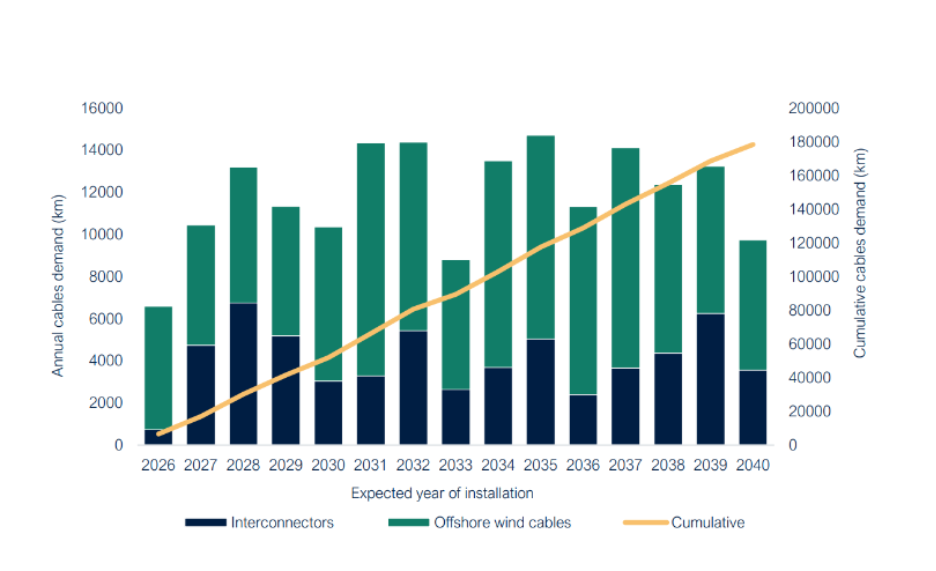 Image: Annual subsea cable demand remains elevated through 2040, with cumulative demand reaching ~178,000 km, driven primarily by offshore wind expansion.
About TGS
TGS provides advanced data and intelligence to companies active in the energy sector. With leading-edge technology and solutions spanning the entire energy value chain, TGS offers a comprehensive range of insights to help clients make better decisions. Our broad range of products and advanced data technologies, coupled with a global, extensive and diverse energy data library, make TGS a trusted partner in supporting the exploration and production of energy resources worldwide. For further information, please visit www.tgs.com (https://www.tgs.com/).
For media inquiries, contact:
Bård Stenberg
IR & Business Intelligence
investor@tgs.com