

OSLO, Norway (16 June 2026) — Europe could face a cumulative shortfall of more than 22,000 km of high-voltage subsea cable capacity between 2026 and 2040 under current procurement and manufacturing assumptions, creating a challenge for future offshore wind and transmission projects.
That is according to a new TGS | 4C white paper assessing the feasibility of delivering the Hamburg Declaration's ambition to develop up to 100 GW of cross-border offshore wind capacity in the North Sea region by 2050.
Signed by nine North Sea countries in January 2026, the Hamburg Declaration sets out a framework for developing cross-border offshore wind projects, offshore hybrid assets and interconnector infrastructure to support a more integrated European energy system. The white paper examines the technical, commercial, regulatory and supply chain factors that will influence whether the Declaration's objectives can be achieved.
The analysis highlights mounting pressure on the subsea cable supply chain as offshore wind and interconnector deployment accelerate. Europe could face an annual shortfall of up to 27% of its total supply capacity for cables exceeding 132 kV, cumulatively amounting to approximately 22,800 km between 2026 and 2040.
Given that new manufacturing capacity cannot be brought online quickly enough to respond to near-term demand, even a sustained deficit of this scale risks creating significant supply bottlenecks and project delays. With investment-to-commissioning timelines for high-voltage cable infrastructure typically spanning four to six years - as illustrated by recent greenfield facilities entering development - capacity commitments made today are critical to resolving anticipated supply constraints in the mid-2030s. Sumitomo Cables’ investment in Scotland reflects this strategic imperative.
Additionally, the European subsea cables market is characterised by a strong regional preference for local suppliers. Historical contract awards show that European manufacturers have secured approximately 91% of subsea cable manufacturing contracts in Europe. These market dynamics reflect Europe's preference for a local supply chain.
The report also identifies growing pressure on project delivery timelines. Analysis of the European interconnector pipeline found that the average project currently requires approximately 13.3 years to progress from planning through to commissioning, raising questions over the industry's ability to deliver the Hamburg Declaration's interim ambitions within the required timeframe.
In addition to supply chain and delivery challenges, the white paper examines the role of multi-purpose interconnectors and cross-border transmission infrastructure in supporting future deployment. The analysis highlights the need for clearer regulatory frameworks, investment structures and revenue mechanisms to improve project certainty and accelerate delivery.
The study explores what actions may be required to bridge the gap between current market realities and the Hamburg Declaration's long-term ambitions, examining the role of manufacturing investment, infrastructure planning and regulatory reform in supporting future deployment.
"The Hamburg Declaration represents one of the most ambitious offshore energy initiatives currently being pursued in Europe," said Rameeza Haq Duggal, Principal Analyst, TGS | 4C and lead author of the white paper. "The question is not whether the ambition is desirable, but whether the industry can overcome the supply chain, infrastructure and regulatory challenges that stand in the way of delivery. Understanding those challenges is the first step towards addressing them."
The full white paper, Assessing the Deliverability of 100 GW of Cross-Border Offshore Wind by 2050: The Hamburg Declaration, is available to download from the TGS | 4C website.
The report forms part of the company's ongoing analysis of offshore wind, offshore transmission and energy infrastructure markets, providing stakeholders with data-driven insights into the challenges and opportunities shaping Europe's energy transition.
TGS | 4C provides intelligence reports on offshore energy trends via its 4C Intelligence platform. As a division of TGS, a leading energy data and intelligence provider, it also offers consultancy services for offshore projects, including offshore wind, subsea power cables, telecommunications, pipelines, and geospatial IT and GIS services. For further information, please visit www.tgs4c.com (https://www.tgs4c.com/).
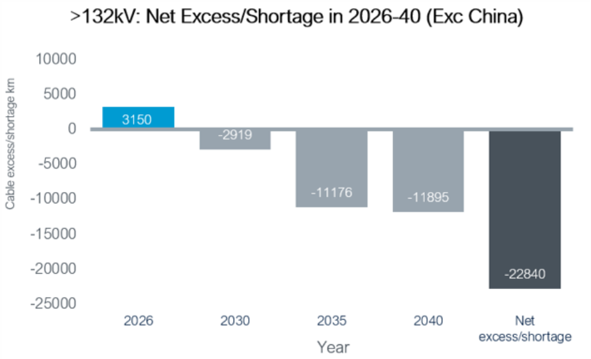
Image: Projected European High-Voltage Subsea Cable Supply Gap, based on analysis from TGS | 4C.
About TGS
TGS provides advanced data and intelligence to companies active in the energy sector. With leading-edge technology and solutions spanning the entire energy value chain, TGS offers a comprehensive range of insights to help clients make better decisions. Our broad range of products and advanced data technologies, coupled with a global, extensive and diverse energy data library, make TGS a trusted partner in supporting the exploration and production of energy resources worldwide. For further information, please visit www.tgs.com (https://www.tgs.com/).
For media inquiries, contact:
Bård Stenberg
IR & Business Intelligence
investor@tgs.com