

OSLO, Norway (September 21, 2026) — Offshore wind is continuing to deliver projects in 2026, but the pipeline of new investment remains under pressure, according to TGS | 4C’s latest quarterly Global Market Overview.
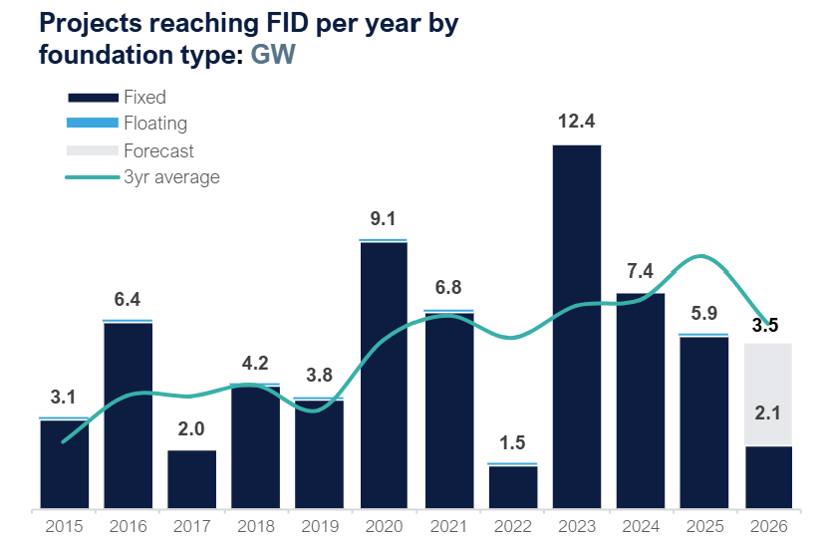
Only 2.1 GW has reached final investment decision so far in 2026, while more than 12 GW is expected to enter operation this year. By year-end 5.6 GW is expected to reach FID, which would make 2026 the second-lowest year for offshore wind investment decisions since 2020.
Final consent awards are advancing strongly, with 22.2 GW forecast to receive consent in 2026, making it the second-highest year on record.
The contrast highlights a central challenge facing the industry: both early-phase development assets and projects under construction are progressing, yet developers remain cautious about committing capital to the next generation of projects.
“2026 is turning into a year of contrasts for offshore wind,” said Ivar Slengesol, Managing Director and VP of TGS | 4C. “While energy security concerns are giving offshore wind a political boost, general market uncertainties are making financing more challenging. The next phase will depend on whether governments, developers and the supply chain can create the conditions needed to unlock the projects already in development.”
Geopolitical uncertainty and high costs weigh on industry
Global offshore wind capacity currently stands at around 92.7 GW in operation, with a further 41.2 GW under construction and 7.1 GW at FID.
New projects continue to face economic pressure. Prolonged geopolitical uncertainty, higher financing costs and rising commodity prices are increasing the cost of developing and financing offshore wind projects. Long-term borrowing costs in the UK, US and euro area remain around their highest levels in 15 years, while steel prices are 53% higher year-on-year.
Financing costs are a critical factor in whether projects proceed. TGS | 4C estimates that a one percentage-point increase in the cost of capital can increase the levelised cost of electricity for an offshore wind project by around 9–11%.
Foundations analysis: structural supply chain crunch unlikely
The latest report also provides a detailed assessment of the offshore wind foundation market, with around 19,400 foundations forecast to be installed globally between 2026 and 2040.
Monopiles remain the preferred foundation type, while floating foundations are expected to account for 11% of demand. In Europe, available monopile and jacket manufacturing capacity means a structural supply shortage is unlikely.
“Our latest analysis gives developers, EPC contractors and investors a clearer view of where supply-chain risk and opportunity are likely to emerge through 2040. By examining the foundations needed to support future projects, the report provides greater visibility of the supply-chain capacity required to deliver future growth,” said Jordan May, senior analyst and lead author of the Global Market Overview.
Long-term outlook revised
TGS | 4C has also revised its long-term global offshore wind outlook to around 474 GW by 2040. The revision reflects continued uncertainty around project economics, financing, policy and delivery timelines.
The Quarterly Market Overview Report is available exclusively to TGS | 4C subscribers, providing detailed forecasts, regional analysis and insights into policy, auctions and project pipelines across global offshore wind markets. This edition also introduces a new deep dive into offshore wind foundation concepts.
The TGS | 4C team will be at Stand B4.413 during WindEnergy Hamburg 2026 to discuss the latest offshore wind market outlook and what it means for developers, suppliers and investors.
TGS | 4C provides intelligence reports on offshore energy trends via its 4C Intelligence platform. As a division of TGS, a leading energy data and intelligence provider, it also offers consultancy services for offshore projects, including offshore wind, subsea power cables, telecommunications, pipelines, and geospatial IT and GIS services. For further information, please visit www.tgs4c.com (https://www.tgs4c.com/).
About TGS
TGS provides advanced data and intelligence to companies active in the energy sector. With leading-edge technology and solutions spanning the entire energy value chain, TGS offers a comprehensive range of insights to help clients make better decisions. Our broad range of products and advanced data technologies, coupled with a global, extensive and diverse energy data library, make TGS a trusted partner in supporting the exploration and production of energy resources worldwide. For further information, please visit www.tgs.com (https://www.tgs.com/).
For media inquiries, contact:
Bård Stenberg
IR & Business Intelligence
investor@tgs.com