

First Published: AAPG Explorer - April 2026, by Andrew Hartwig (TGS)
For over 40 years, multi-client seismic data has been a quiet and steadfast engine propelling global exploration. Central to play-opening discoveries from the North Sea to the Southern Atlantic, multi-client seismic surveys have consistently foreshadowed the trajectory of the energy landscape, and there is no better example than offshore Brazil. The 2023 merger between geophysical giants TGS and PGS created a seismic juggernaut uniquely positioned to drive the next generation of frontier exploration. A key territory for the new company and the broader industry is South America’s largest energy producer, Brazil.
Unprecedented pre‑salt discoveries between 2006 and 2013 vaulted the Brazilian salt basins to the forefront of global exploration. On the other hand, creaming curves indicate a plateau in the rate of impactful discoveries since then. Santos and Campos basins continue to set the standard for giant pre-salt carbonate reservoirs; however, as production accelerates in prolific fields such as Tupi, Búzios, Atapu, and others, replacing these reserves will be essential to sustaining global energy supply and supporting Brazil’s long-term economic ambitions.
Brazil’s Exploration Landscape
The offshore Brazil salt basins have been harvesting discoveries for much of the past decade. Despite exploration challenges and a bid round hiatus in 2024, positive results at the Aram and Agua Marinha blocks have sustained an optimistic outlook. In parallel, TGS has been strengthening its seismic library by advancing regional reprocessing programs such as Picanha and Vision 3Ds and completing 10 new streamer surveys since 2020 (Figure 1). Surveys such as Potiguar Ph1 (2020), Seal Pirambu (2020), Santos 3D (2021), Campos 3D (2021), Campos Deepwater (2022), Amapa Ph2 (2024), Santos Sul (2024), Seal Bonita (2024), Pama Ph1 (2025), Pama Ph2 (2026), and Pelotas Sul (2026) are preparing the next wave of frontier exploration.
In 2025, bid round activity rebounded in the salt basins as high-profile pre-salt blocks such as Jaspe, Citrino, Esmeralda and Ametista were awarded within the TGS library footprint, underscoring the value of fit-for-purpose exploration seismic and revealing a rising risk appetite among major NOCs like CNOOC and midsized independents like Karoon.
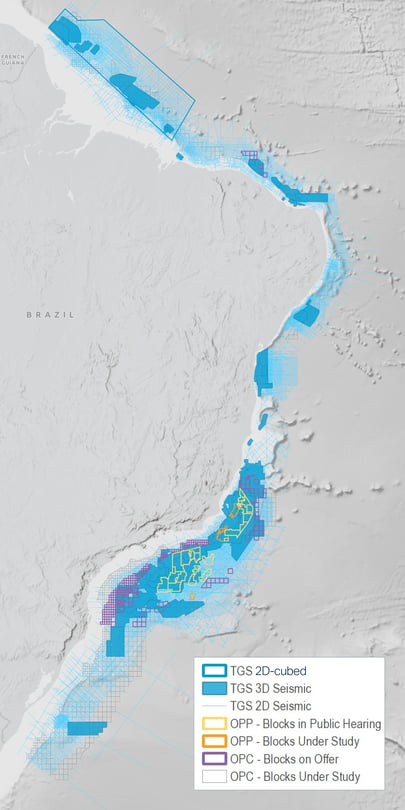 Figure 1: TGS’ multi-client Data Library offshore Brazil displaying 2D and 3D seismic datasets and current OPP, OPC blocks, as well as blocks under study for future release.
Current interest in these mature basins is being driven by the potential release of 26 new Production Sharing (OPP) blocks, including the Hematita, Safira, Opala, Malaquita, and Calcita clusters. Despite exhibiting prospective pre-salt mounded geometries overlying a proven source kitchen, uncertainty persists regarding the size of potential discoveries within these blocks. As a result, the industry is diversifying its plays and exploring larger, riskier targets across an extensive inventory of Concession (OPC) blocks in 2026 and beyond.
Geologist and exploration consultant for TGS, Pedro Zalan, comments: “The necessity for Brazil to find new petroleum provinces capable of maintaining the present high rates of production is mandatory! Two frontier provinces that stand out as possible suppliers of large productions of oil and gas: the Brazilian Equatorial Margin (BEM) and the Pelotas Basin.” Consistent with Zalan’s outlook, momentum is surging along the Equatorial Margin, from Foz do Amazonas to the Potiguar Basin, aligned with TGS’ seismic survey ‘bookends,’ Amapa 3D and Potiguar 3D.
In southern Brazil, TGS again demonstrated first-mover mentality by acquiring its Santos Sul 3D survey (Figure 2), positioned strategically for exploration campaigns by Total, CNOOC, Shell, and Ecopetrol as they shift exploration efforts from Santos Basin into northern Pelotas.
Driven by ambitious exploration mandates from Petrobras, Chevron and Shell, the Pelotas Basin awarded 47 blocks across the 4th and 5th OPC rounds in just two years, reaffirming the strategic return to frontier exploration.
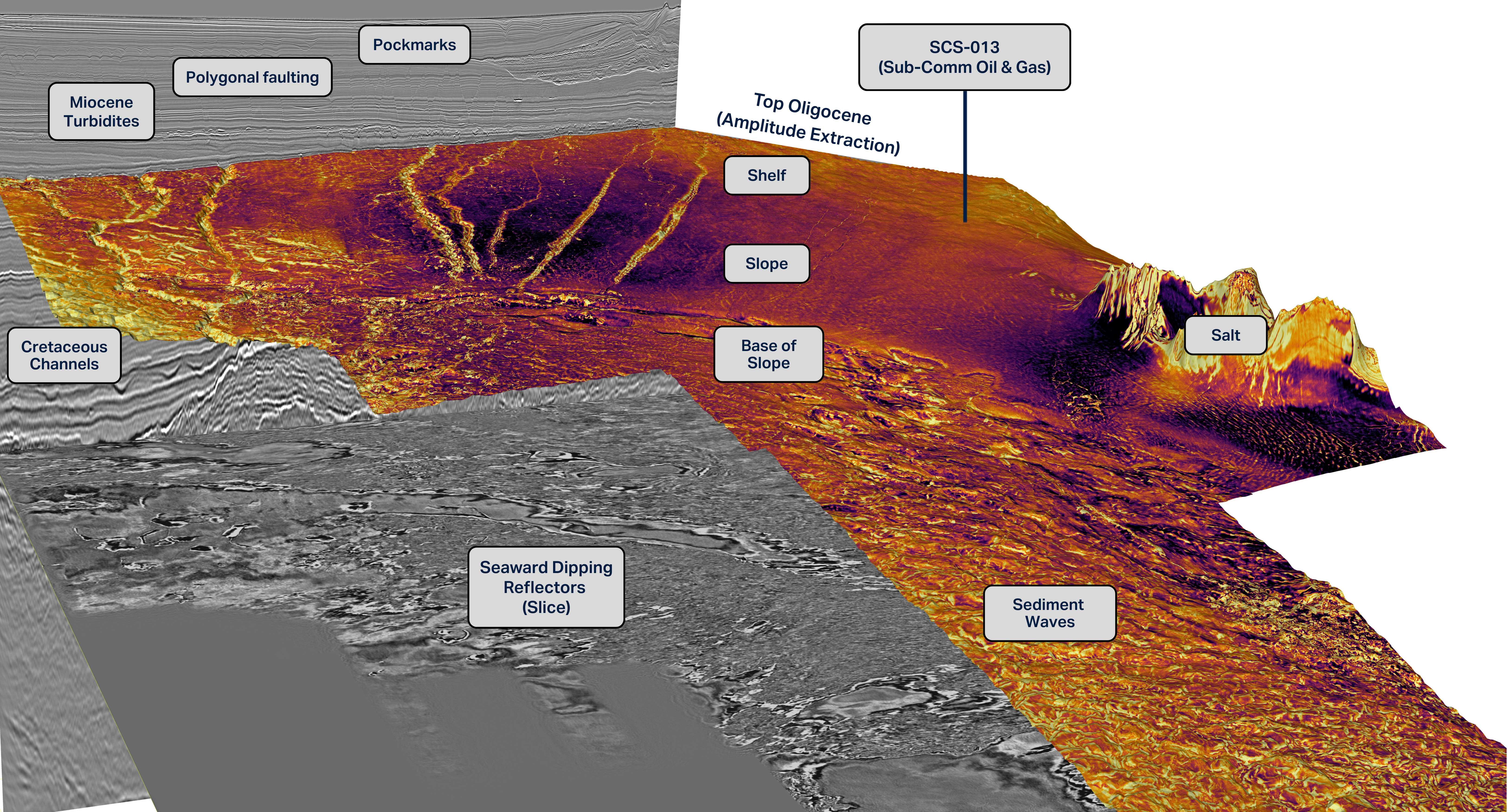 Figure 2: Chair view of TGS’ Santos Sul 3D multi-client dataset with Top Oligocene surface highlighting tertiary depositional systems directed towards deepwater blocks in Northern Pelotas Basin.
Equatorial Margin Momentum
Brazil’s Equatorial Margin spans ~750,000 km² of remote, largely under-explored offshore territory. Its conjugate margin in West Africa is shared by eight countries, each with its own energy strategy. Brazil’s advantage in scale is also its dilemma: how to consistently and commercially develop energy infrastructure in the region without compromising the environment, culture, or legacy of the Amazon rainforest and tropical offshore ecosystems. Such challenges must be navigated with precision and as seen in frontiers worldwide, seismic data serves as the tip of the spear addressing all these issues.
David Hajovsky, Executive Vice President of TGS Global Multi‑Client, underscores the strategic significance of TGS’ multi‑client data: “We lay the groundwork on how to work in a given area. What’s going to be needed and necessary. And with that framework we lay down there in terms of establishing a lot of those local partnerships… that allows then the next step in the value chain to occur… and what we want to see is success in that case because then we can sit back some years from now and look back and say, we did our part in a sustainable and practical way.”
TGS’ most recent example of this operation is its latest survey, Pama 3D (Figure 3), where millions of dollars and thousands of hours have been invested to ensure environmental safeguards and geophysical parameterization are precisely tuned to the deepwater objectives.
The new 3D data will refine structural and stratigraphic targets inside robust depositional systems sculpted by expansive volcanic edifices and a gravitational fold-and-thrust belt. Given its strong geologic parallels to the proven petroleum systems of smaller territories, Guyana/Suriname and Ghana/Ivory Coast, it's logical to assume the BEM holds substantial potential, and a discovery could result in production numbers in the order of millions of barrels per day.
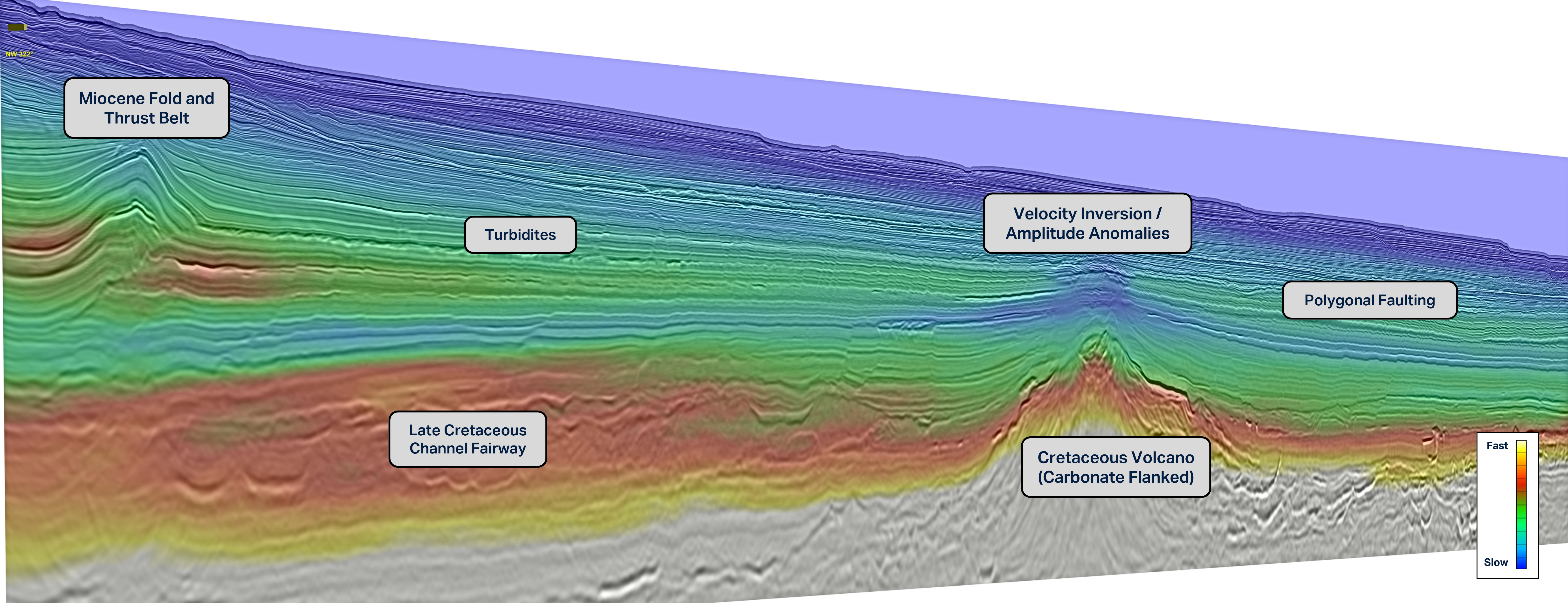 Figure 3: TGS’ multi-client PAMA Phase 1 3D Fast Track from March 2026, showcasing full waveform inversion velocity results in a gravitational fold and thrust belt, and deepwater volcanic edifice.
Meanwhile, to the west, after a decade of preparation, the industry awaits results from Petrobras’ Morpho-1 well inside TGS’ Amapá 3D Phase I survey. Whatever the outcome, operators have signaled a steadfast commitment to long-term investment across the Equatorial Margin.
Pelotas Basin in Perspective
In Southern Brazil, the Pelotas Basin mirrors the exploration trend of the Equatorial Margin and is supported by conjugate‑margin success in West Africa. Seismic character at Namibia’s Graff, Venus, and Mopane discoveries share striking resemblances to 2D signatures in Pelotas, fueling a frenzy of interest during the 2023 OPC round, stimulating further multiclient seismic investment.
The Pelotas Basin, which spans both onshore and offshore Brazil and Uruguay, is approximately 380,000 km², with offshore northern and southern segments separated by Albian carbonates at the crest of the Torres High. Stratigraphic plays range from Miocene to Cretaceous reservoirs, charged by an Albian–Cenomanian–Turonian source rock buried beneath 7-9 km of sedimentary rocks.
TGS recently commenced the Pelotas Sul 3D seismic acquisition program in a permit area of 86,000 km², to be executed in phases based on industry interest, bid-round momentum and geo-prospectivity defined by structural and stratigraphic mapping performed by the TGS Geoscience team.
The Last Pre-salt Frontier
Although momentum from major operators is softening inside the core pre-salt polygon, ANP is continuing to outline new blocks, creating opportunities for independents and smaller players to take a more active role. Meanwhile, territories outside the polygon are rapidly gaining traction.
In August 2025, BP’s announcement of a major discovery at its Bumerangue well reenergized frontier pre-salt exploration. More than 400 km offshore, the 1,000 m carbonate reservoir section drilled in 2,300 m of water confirms that significant pre-salt structures extend basinward of the traditional Santos Outer/External High. A seismic cross-section tying Bumerangue to Equinor’s block S-M-1617 within TGS’ Santos 3D survey reveals the complex interconnectivity of the outboard petroleum system and validates exploration potential in the external domain. Seismic reprocessing utilizing cutting-edge Elastic Dynamic Matching FWI (E-DMFWI) is now illuminating and de-risking prospective four-way anticlines shaped by intricate salt tectonics and fault networks seen in attribute extractions (Figure 4).
These seismic-driven insights not only reveal the extension of the pre-salt play fairway but also illustrate how the multi-client survey predicted today’s exploration activity five years in advance of acreage being awarded.
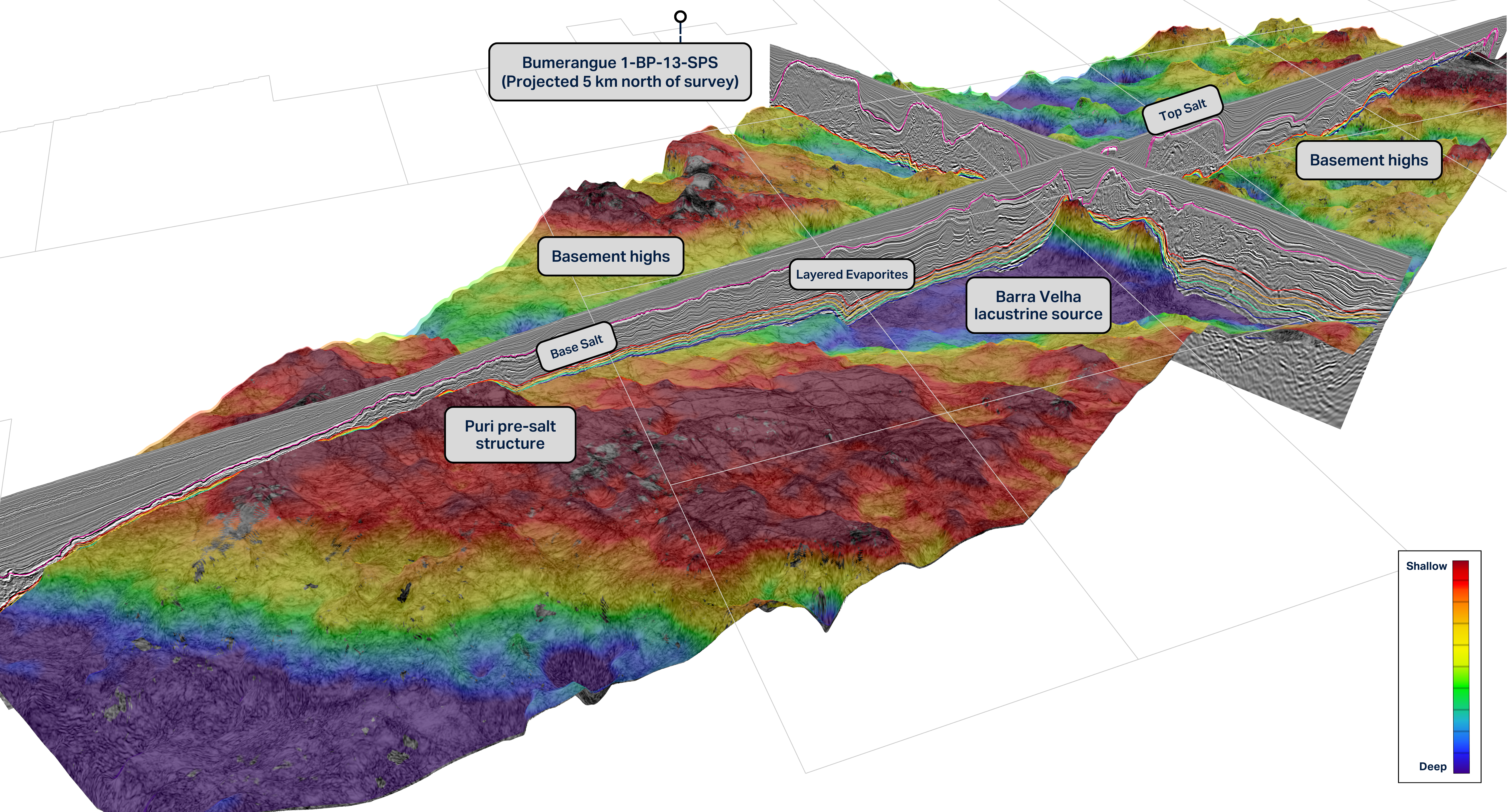 Figure 4: 3D perspective of TGS’ multi-client Santos 3D survey with basement map revealing giant pre-salt structures beyond Brazil’s Exclusive Economic Zone where E-DMFWI imaging technology is de-risking new prospectivity.
When asked about Brazil’s last pre-salt frontier, Zalan offers an optimistic outlook: “The pre-salt is far from dead…” He explains, “In Santos, beyond the EEZ, super-giant structures present all characteristics necessary for successful pre-salt prospects. In the outboard Campos Basin, large crops of buildups of classical microbialite and travertine facies sit atop large, strongly faulted, pre-salt grabens resembling the producing fields of Santos Basin.”
Accordingly, Brazil’s pre-salt may still have much more fuel in its tank.
Future Bid Rounds and Activity
More than 20 additional blocks are under study near BP’s Bumerangue, Equinor’s S-M-1617, and CNOOC’s Ametista, collectively signaling an industry push toward the distal edge of the pre-salt lacustrine basin. As the Brazilian salt basins continue to mature, the Equatorial Margin and Pelotas Basin are prepping to carry the torch, and multi-client seismic is paving the way for an efficient transition to these next frontiers.
With seismic permits spanning Brazil’s Equatorial and Pelotas basins, TGS’ mix of legacy reprocessing and active acquisition fleet provides a strategic edge, enabling frontier exploration across Amapá, Pará‑Maranhão, Barreirinhas, Ceará, Potiguar, and Pelotas basins.
In an era of rapid change and heightened pressure, unique challenges create unique opportunities, and offshore Brazil is no exception. The salt basins may not be exhausted yet, but new frontiers are already stepping into view, and their subsurface is clearly imaged thanks to TGS’ multi-client seismic.