


First Published: First Break - May 2026, by Felicia Winter, Thomas Hansen, Roberto Ruiz and Jon Rogers, TGS
Abstract
Reprocessing legacy 3D seismic data with modern broadband imaging workflows has become a powerful tool for improving structural resolution and amplitude fidelity in frontier and mature basins alike. However, enhanced seismic detail does not automatically translate into improved exploration decisions, particularly when evaluating amplitude versus offset (AVO) and amplitude versus angle (AVA) responses calibrated to borehole data. This article examines how integrated and iterative workflows combining modern reprocessing, rigorous AVO quality control, rock physics analysis, and seismic attribute screening can be used to assess whether amplitude fidelity improvements are both real and fit for purpose.
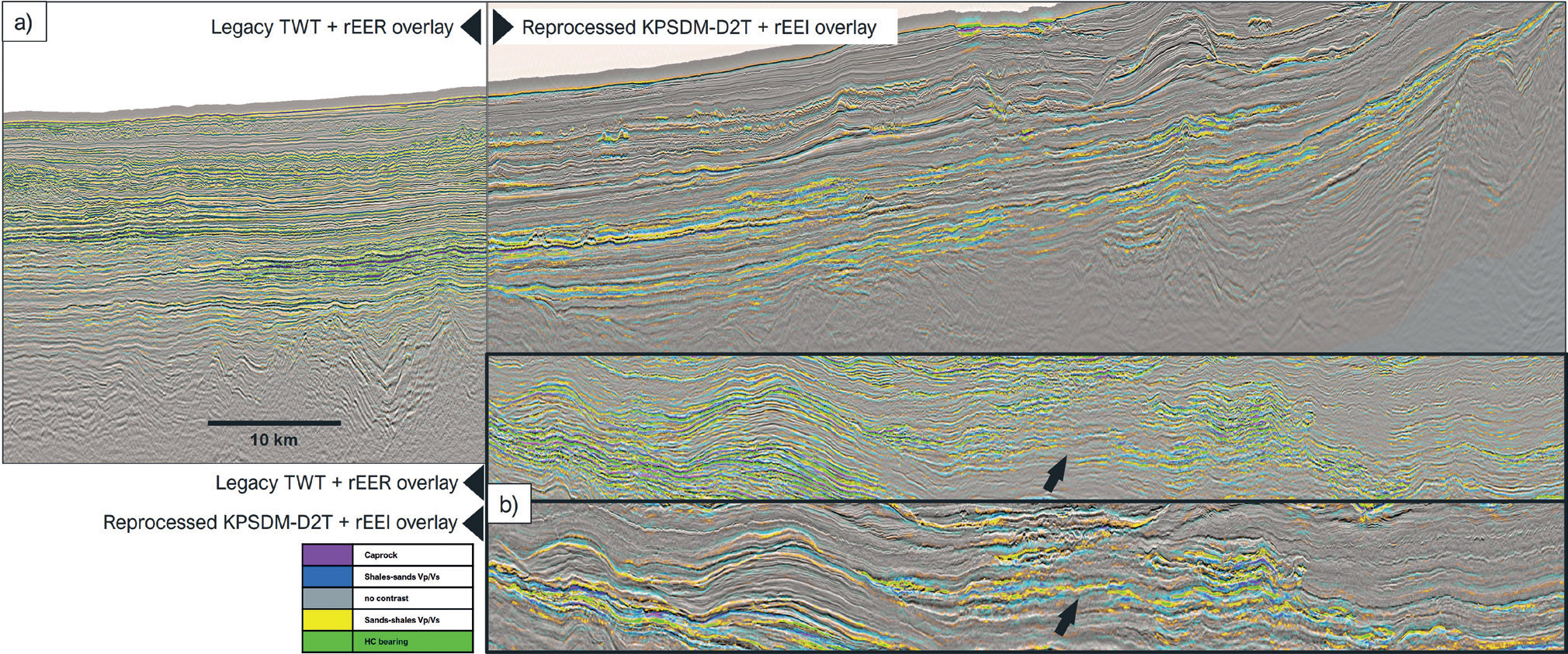
Offshore Sierra Leone, comparisons of rEER overlay on legacy time stack (left) and 2025 reprocessed Kirchoff depth migrated stack to time (right). The section in a) shows improved consistency in seismic facies and attributes, where mainly the fairways and gas caps show an anomaly compared to the legacy stack, lighting up in different magnitudes over the entire sediment column. The zoom-ins of b) show improved continuity at the target levels, which also means removal of false positives in the surrounding matrix (top legacy stack, bottom reprocessed stack).
Using case studies from offshore the Republic of Ghana, the Republic of Guinea, Sierra Leone, and Côte d’Ivoire, we demonstrate how modern broadband reprocessing, including deghosting and full waveform inversion, stabilises pre-stack seismic responses and improves well to seismic ties. We show that higher fidelity data often reveal geological complexity previously unresolved in legacy volumes, providing robust calibration using rock-physics-based AVO modelling, and that relative elastic impedance attributes enable confident discrimination between lithological and fluid-related anomalies. The results highlight that improved imaging shifts exploration uncertainty away from data quality and toward genuine geological risk, enabling more reliable AVO-driven prospect evaluation across regional seismic datasets.
Read the full article here.