


First Published: The Leading Edge - February 2026, by R. Alai, A. Ghazali, F. Ghazali, M. Pua, E. Kamarudin, G. Malo-Paul, H. Hasnan, G. Coskun, Y. Sufian, S. Kumar, M. Sarif, K. Khalid (PETRONAS); M. Preston, S. Dong, G. Zhan, F. Liu, R. Collings (TGS); S. Shaw, O. Barrios-Lopez (Halliburton)
Abstract
The South Asia region hosts multiple prolific play types in its Tertiary basins. It is common to see cycles of carbonates and siliciclastic reservoir targets distributed from very shallow levels to deep early basin fills. The presence of thick, high-impedance carbonate layers with highly variable geometry at mid-section poses significant challenges for imaging productive deeper target levels. Over the years, numerous studies have explored methods to enhance pre-carbonate imaging, from acquisition strategies to the application of specialized technologies during seismic data processing. Here, mode conversions at the high-impedance contrast interfaces of these carbonate layers were explored and used in improving imaging of the target sections. In a shallowwater survey in the Asia Pacific region, surface data (marine and ocean-bottom node) and borehole data (3-component vertical incidence vertical seismic profiling [VSP] and 3D distributed acoustic sensing [DAS] VSP) were acquired to advance subsurface imaging.
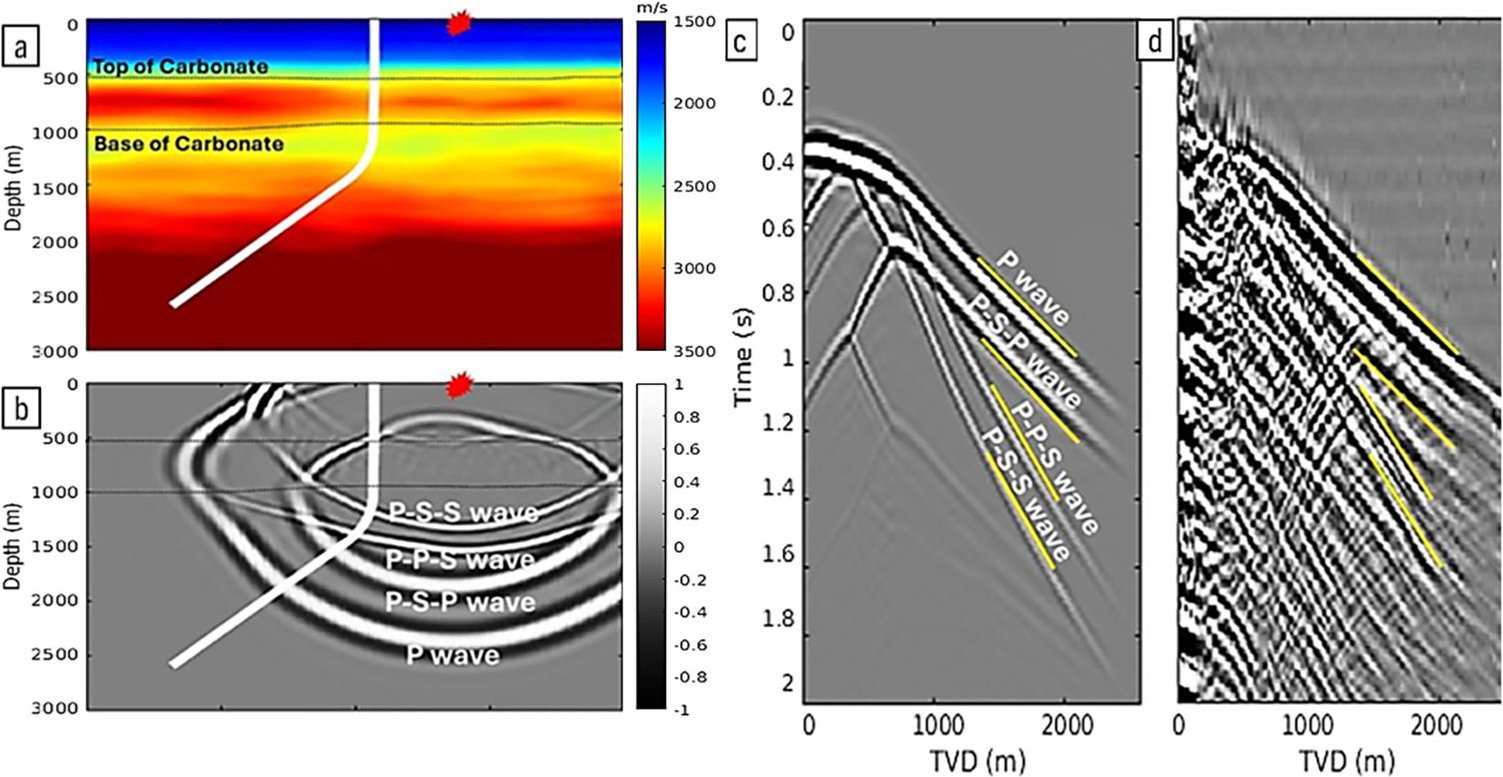
Wave mode conversions with P-waves propagating through a carbonate layer: (a) P-wave velocity model, with the red dot indicating the surface shot location and the white line representing the fiber-optic cable; (b) snapshot of the elastic wavefield, highlighting multiple mode conversions at the carbonate layer; (c) synthetic modeled VSP; and (d) DAS VSP.
In standard DAS VSP data processing workflows, energy not associated with primary P-waves is often attenuated or removed as noise. In contrast, the importance of this noise, comprising mode-converted and multiple energy, was highlighted, as it played a critical role in improved pre-carbonate imaging. Imaging using this mode-converted and multiple energy was shown to have great potential to provide additional insight into the reservoir structures beneath the shallow carbonates. A 3D VSP survey using a wireline fiber-optic cable was conducted in a deviated well. Despite the single-component limitation of DAS recording, the acquired 3D DAS VSP data captured P-waves and notable converted waves, resulting from mode conversions within a shallow, high-velocity carbonate layer. This paper highlighted key findings from the analysis of the 3D DAS VSP data and examined the possibility of using converted waves and multiple energy for DAS VSP deeper carbonate imaging in a geologically complex setting.
Read the full article here.