

First Published: First Break - April 2026, by Kristian B. Brandsegg, Sougata Halder, Allan McKay, Bent Kjølhamar and Gunhild Myhr (TGS)
Abstract
The rapid scale-up of carbon capture and storage (CCS) on the Norwegian Continental Shelf requires robust, cost-effective subsurface screening, characterisation, and long-term monitoring solutions. Advances in marine seismic acquisition and processing play a central role in reducing geoscience uncertainty and accelerating storage site maturation. This article highlights recent technological achievements in CCS enablement, demonstrated by the Elephant CCS project in the Norwegian Sea, a large-scale multi-client dataset repurposed for carbon storage applications.
The Elephant project leverages modern 3D broadband seismic data processed using both pre-stack depth migration and high-fidelity velocity model building. A key innovation of the dataset used to mature the Elephant CCS site is its ability to resolve depositional architectures and stratigraphic heterogeneity relevant to horizontal permeability distribution and plume migration behaviour. Broadband processing and geomorphological interpretation provide new insights into reservoir continuity and seal effectiveness, critical for derisking site selection and informing dynamic modelling. Furthermore, the project demonstrates how multi-client seismic libraries can form a scalable foundation for future 4D seismic monitoring, establishing a baseline for time-lapse surveillance of CO2 injection.
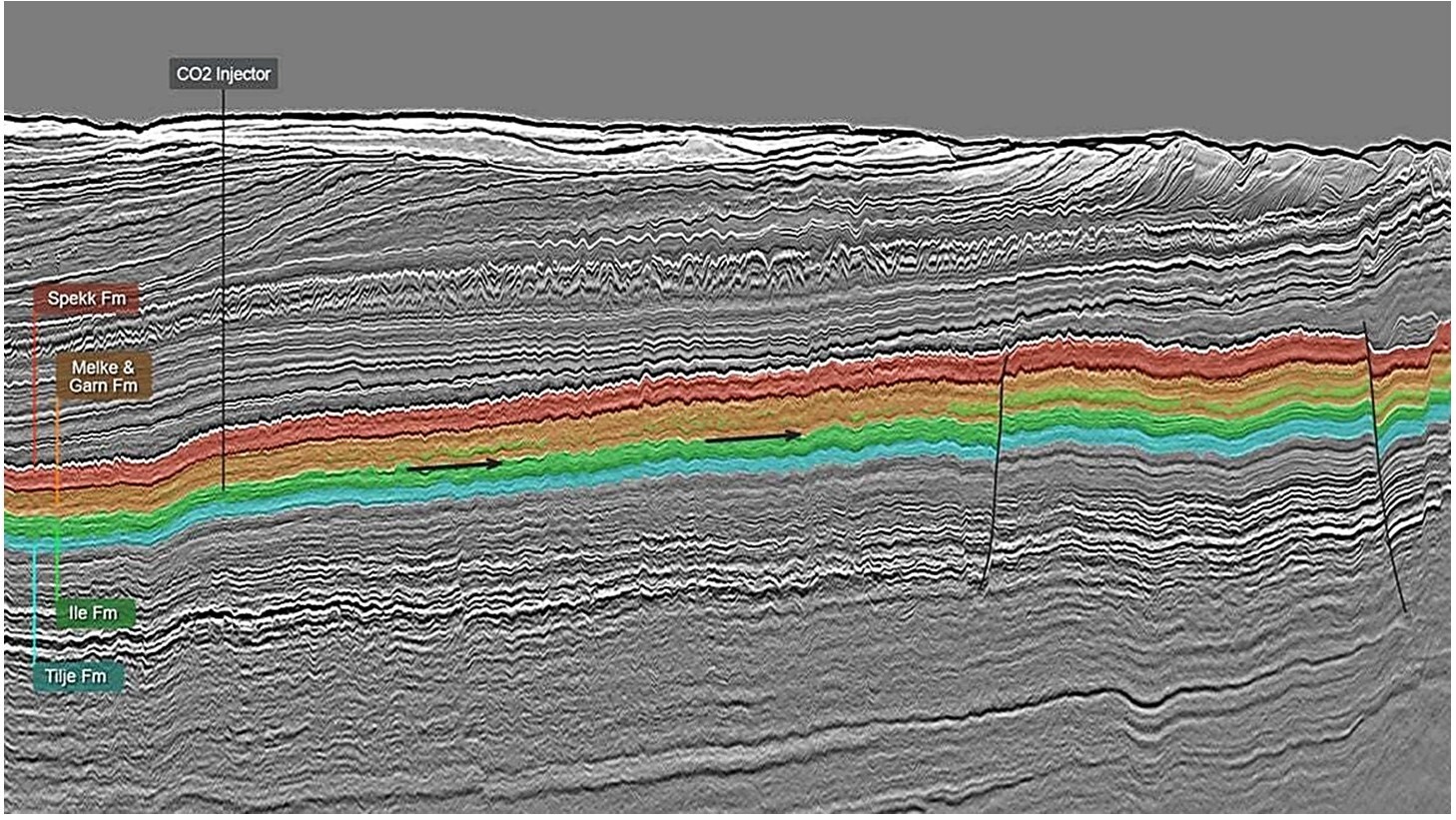
Regional schematic section through the proposed Elephant open aquifer storage site illustrating the prospective aquifer packages and the overlying shaly Spekk Formation regional seal for carbon storage within Jurassic sandstones. The notion is to inject CO2 down dip and allow migration to allow CO2 to trap residually and in dissolution.
Together, these advances illustrate how the repurposing of high-quality seismic data and state-of-the-art geophysical workflows can significantly lower entry barriers for CCS projects. The Elephant CCS project exemplifies the utilisation of high-quality seismic data combined with analytical tools and workflows for delivering fit-for-purpose subsurface intelligence to support Norway’s ambition for gigaton-scale CO2 storage and the broader energy transition.
Read the full article here.