

First Published: GEO ExPro - Exploration Opportunities, April 2026, by Andrey Bogachev and Clay Westbrook, TGS
Abstract
The Gulf of America is a vital part of US energy infrastructure, with its future increasingly dependent on new seismic technologies to tackle complex geology. As exploration advances into saltdominated regions, operators are relying on advanced imaging and novel acquisition technologies to better map subsurface formations, improving visibility beneath salt layers and deepwater sediments that previously hid critical structures.
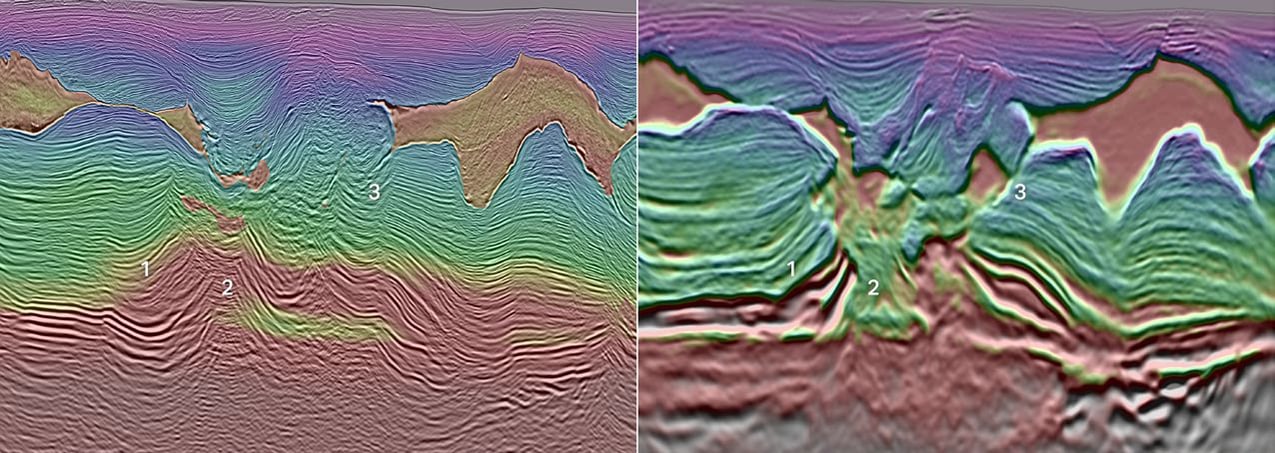
Early-Out 10 Hz E-DMFWI FDR (right) shows improved structural placement (1), better salt feeder definition (2), and salt-sediment interface (3), relative to the legacy WAZ streamer RTM (left).
Gulf of America: Integrating technologies to see beyond the salt
The Gulf of America (GOA) remains a central pillar of US energy infrastructure, and its future potential is increasingly tied to the integration of new seismic technologies that can address the region’s complex geology. As exploration moves deeper into salt-dominated provinces, operators are turning to advanced acquisition and imaging solutions capable of resolving the entire subsurface column, from the seafloor through thick, rugose salt and into pre-salt and basement intervals. These integrated technologies, which combine innovative source designs, ultra-long offset acquisition, and high-end imaging workflows, are dramatically improving illumination beneath salt and deepwater sediments, revealing structures that were previously obscured by complex velocity regimes and challenging overburden.
Read the full article here.