

Highlights from TGS and across the industry in 2025
This week we’ll take a step back and review key stories from this past year, things to watch as we move into 2026, an update on US oil output, and a grab bag of stats and updates from 2025. Happy New Year, and on to 2026!
One Big Story from 2025: Western Haynesville Rush
In early 2025, a handful of Comstock Resources wells were completed in East Texas, with results that raised eyebrows and drew attention across the industry. With the development of multiple NGL export facilities ongoing and a slow decline of new opportunities in the legacy Haynesville play, this new opportunity emerged at the perfect time.
The deeper Bossier and Cotton Valley formations have been continuously developed in the area for decades, but in the early 2020’s there was an inflection point that highlights the onset of testing and development of the Western Haynesville play (fig 1). Although the production profiles and economics in the significantly deeper Western Haynesville are still slightly less favorable than the legacy Haynesville, that gap is quickly closing (fig 2). Read more about the Western Haynesville here.
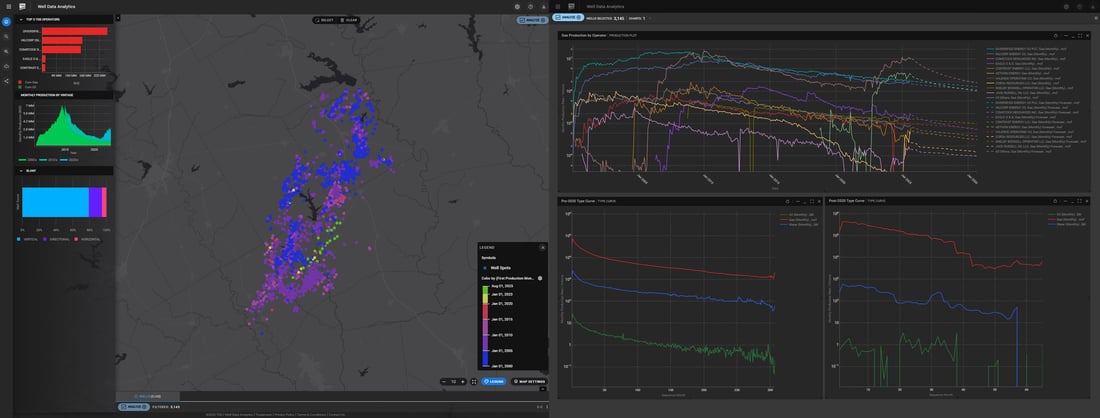
Figure 1. Western Haynesville Overview and Production Profiles
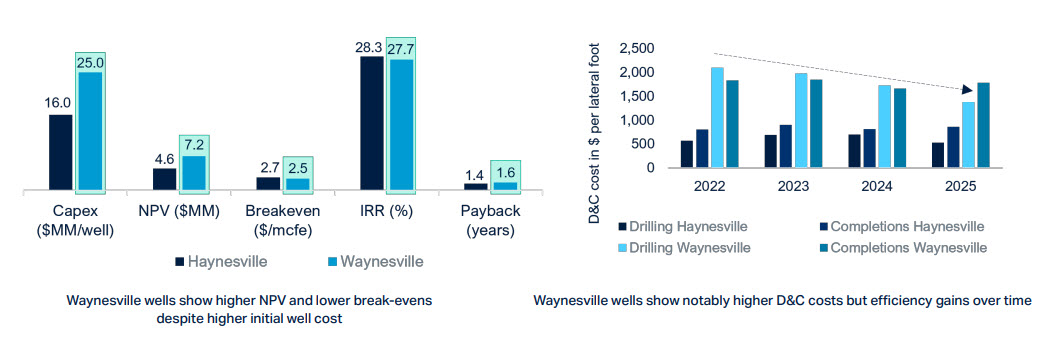
Figure 2. Economic Comparison of Legacy Haynesville and Western Haynesville
One Big Story to Watch in 2026: Midland Basin Barnett Development
Traditional Permian Basin targets in the Wolfcamp and Bone Springs intervals appear to be reaching maturity. Factors such as increased economic constraints, continual rounds of consolidation, depletion of tier 1 acreage, and ever rising water production have turned this once extraordinary growth machine into a precisely optimized plateau. However, amongst this transformation a new play is developing, the deeper Barnett Formation in the core of the Midland Basin. While better known for its prolific dry gas in the Fort Worth Basin, the Barnett exhibits significantly less thermal maturity in the Midland and therefore yields volatile oil. The Midland Barnett does come with a slightly higher proportion of natural gas than some of its shallower peers, but critically it also comes with significantly less water (fig 3).
The Barnett has been explored and tested in the Midland as early as 2021, but in 2023 and 2024 testing and early development started to really pick up. And in 2025 the productivity of new wells drilled increased even further (fig 4). The Cobb Pool 3724A 01H well completed earlier this year in the Barnett was even among the top producing wells this year, measured by 90 day oil IP.
With large operators like Occidental Petroleum publicly recognizing the potential, 2026 could see significant Barnett growth. Read more about the Midland Barnett Shale here.
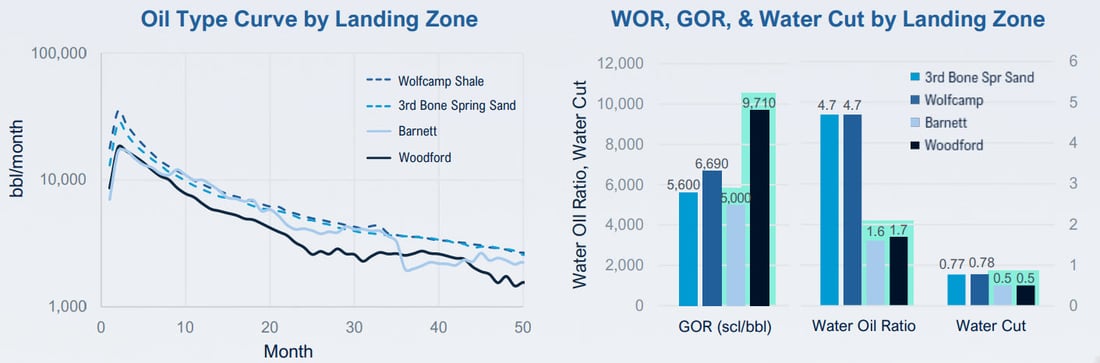
Figure 3. Barnett Benchmark
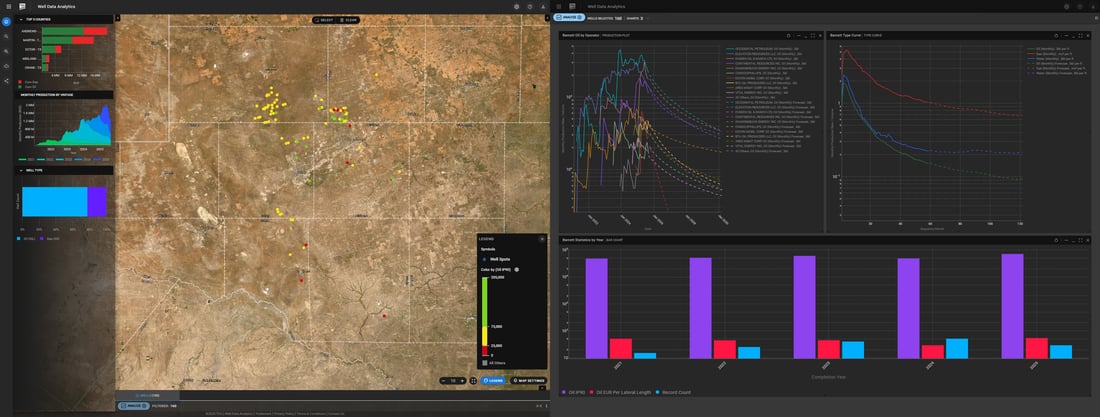
Figure 4. Midland Barnett Overview and Production Profiles
US Oil Production:
As the year draws to a close the TGS US oil production model is predicting that we are on track for 12.7 MMBOPD by the end of the year (fig 5). Amidst the uncertainty of tariffs, global supply shifts, and cost constraints, total US output appears to have remained surprisingly steady. This dissonance is summarized pretty well by a comment on the recent Dallas Fed Energy Survey, “There is no way that the U.S oil production data is correct”. And it's important to remember that real-time, or near-real-time, reporting on gross production from a state, much less the entire country, is extremely difficult without some kind of forward-looking prediction model. We discussed how the TGS model makes those assumptions and predictions here, but in short we use a mixture of standard time-delayed state regulatory reported production, forecasted production for existing wells, and predicted type-well production for new wells drilled after the state-reported time delay based on recorded rig counts and backward looking rig productivity statistics. Periodically we’ll compare our model results with other publicly available reporting, like the EIA, but at the end of the day these are all models with built-in assumptions and predictions. During steady times these models are likely to be fairly accurate, but during times of high volatility, assumptions baked into these models are likely to deteriorate. This is something we will be keeping a close eye on as more accurate data is released over time to recalibrate and update these models. You can track updates to the TGS US Oil model over time here.
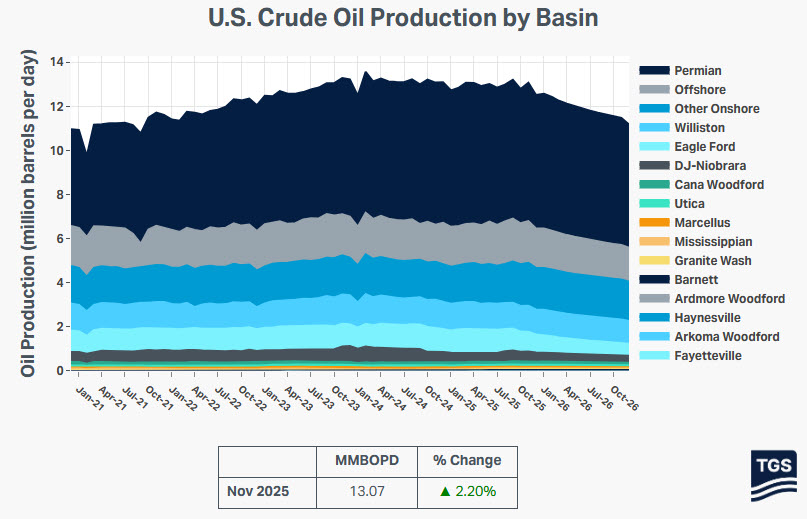
Figure 5. TGS US Oil Production Model
Grab Bag:
Permitting (fig 6):
- 16,800 permits approved so far in 2025
- Top Basins: Delaware, Midland, Gulf Coast, Western Canadian, Appalachian
- Top Permitted Formations: Spraberry Trend Area, Bone Spring, Wolfcamp, Niobrara, Eagle Ford
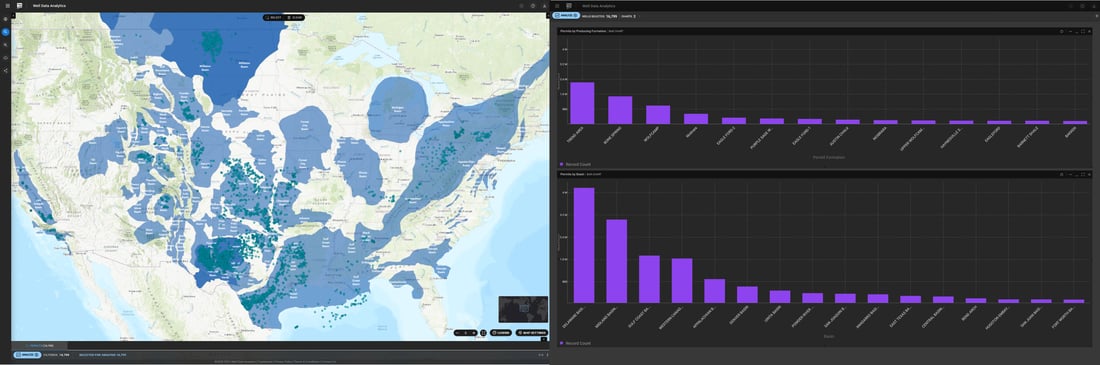
Figure 6. 2025 Permit Map and Statistics
Well Production:
- Top basin by new well production (BOE): Delaware, Gulf Coast, Midland, East Texas, Western Canadian, Anadarko, Powder River
- Top producing formation by new well production (BOE): Eagle Ford, Spraberry Trend Area, Bone Spring, Haynesville, Bakken, Wolfcamp, Niobrara, Austin Chalk
* Not all new wells and production from 2025 have been fully released for every state.
M&A
- 3/10/25: Whitecap Resources Merges with Veren in $15 billion transaction – TGS Coverage
- 11/3/25: SM Energy Merges with Civitas Resources in $12.8 billion transaction – TGS Coverage
- 8/25/25: Crescent Energy Company acquires Vital Energy in $3.1 billion all-stock transaction
- 5/30/25: EOG Resources acquires Encino Acquisition Partners for $5.6 billion – TGS Coverage
TGS Analysis in 2025
- The 5th Cycle of Permanent Offer Acreage: Transforming Brazil's Energy Landscape
- Haynesville Basin Development Analysis: Legacy vs West Haynesville
- Permian Deep Exploration: Barnett
- Midland Basin Wolfcamp B Poster
- Delaware Basin 2nd Bone Spring Poster
For more information about TGS Well Data Analytics or to schedule a demo, please contact us at WDPSales@tgs.com.