

How Geology and Well Results Converge to Define the 2nd Bone Spring’s Core Potential
The Delaware Basin’s 2nd Bone Spring formation remains a major area of focus and one of the Permian’s most productive unconventional targets, ranking second in well activity and oil EUR per lateral foot at 78 bbl/ft just behind the Wolfcamp Shale at 82 bbl/ft in Lea County, the basin’s highest oil productivity area, based on TGS well data.
Leveraging TGS’ seismic, geological, well and economic data together with ComboCurve’s forecasting and economic platform, we generated a detailed evaluation of the 2nd Bone Spring across the Delaware Basin. By integrating reservoir characteristics with well performance trends from 2020–2025, the analysis provides a clear view of how the bench has been developed and where it fits within the basin’s future (Figure 1).
While the era of uninhibited drilling has passed for the 2nd Bone Spring, the interval remains a key component of multi-bench development strategies. It continues to be one of the Delaware Basin’s most resilient and competitive landing zones. As operators shift toward more disciplined drilling and capital return strategies in 2025, identifying where the strongest trends persist and where new ones are emerging will be critical for benchmarking, forecasting, and long-range portfolio planning. para
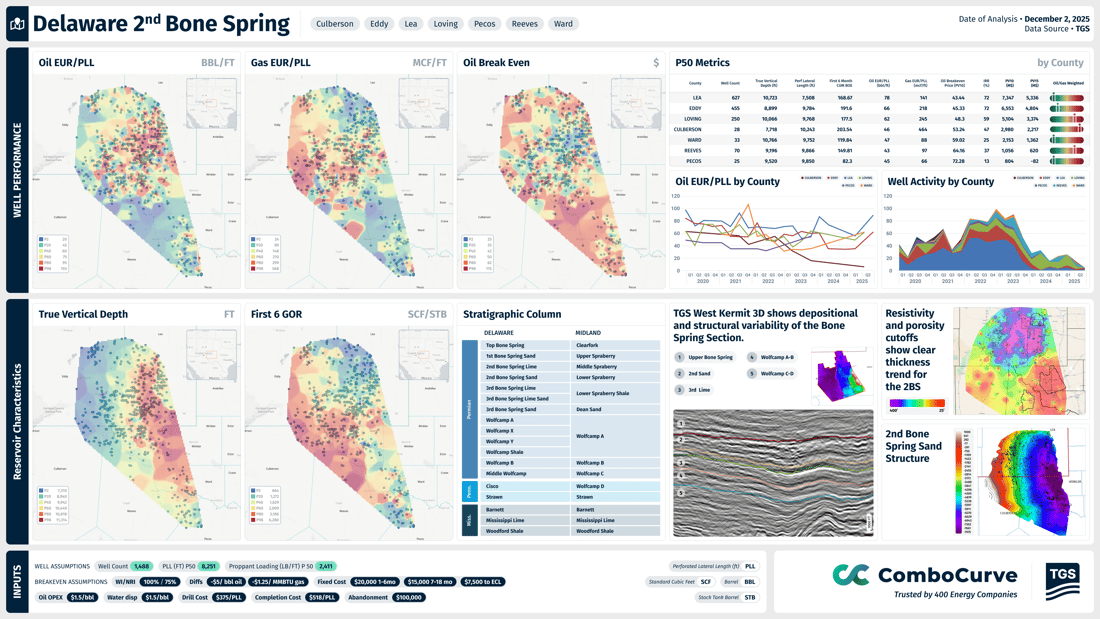
Figure 1. Delaware 2nd Bone Spring regional analysis poster showing well performance maps, P50 metrics by county, reservoir characteristics, and stratigraphic context. Prepared by ComboCurve, Data source: TGS, December 2, 2025
Geologic Framework and Reservoir Architecture
The Bone Spring section dips eastward into the Delaware Basin axis across Lea, Loving, and Ward counties, forming a thick package of clastic and carbonate slumps and debris-flow deposits that pinch out against the Central Basin Platform (Figure 2).
Regional mapping and petrophysical modeling of the 2nd Bone Spring highlight a well-defined depositional fairway of thicker, higher-quality reservoir sands concentrated in eastern Eddy and western Lea counties, with net-to-gross decreasing sharply to the south into Texas.
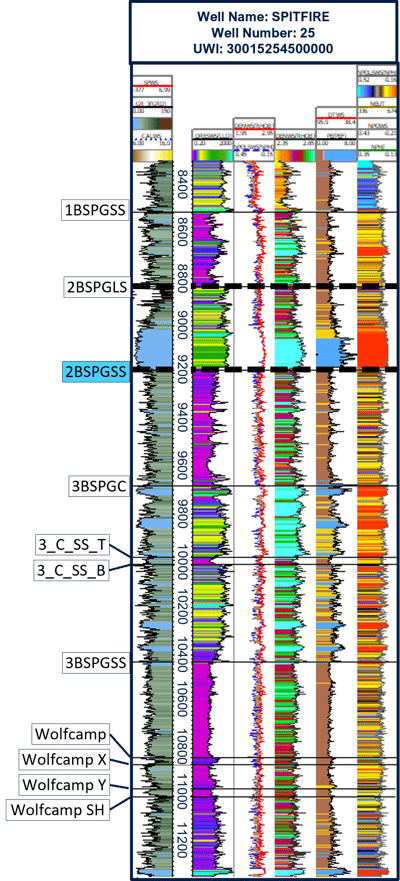
Figure 2. 2nd Bone Spring type log showing the transition from a carbonate signature (clean gamma/high resistivity) to a siltstone signature (gamma in the siltstone range with low resistivity), which corresponds with changes observed in density and sonic logs, provided by TGS Permian Strat Models.
Lower resistivity responses remain a reliable indicator of sandstone presence throughout the interval and, when combined with porosity, are used to define reservoir cutoffs.
TGS’ 3D seismic from the West Kermit area shows notable stratigraphic variability along with subtle structural deformation and drape tied to deep-seated basement faulting. This seismic expression and its implications for stacked-pay development are consistent with the workflow detailed in TGS’ article, “Unlocking Shale Potential: A Case Study on Seismic-Guided Shale Development” which describes how West Lindsey and West Kermit 3D surveys help de-risk Bone Spring and Wolfcamp targets along the basin margin.
Well Performance Across the Basin
The P50 metrics table highlights pronounced differences in well quality and economics across the play:
- Lea and Eddy counties deliver the strongest results, with the highest oil EUR per lateral foot and the most favorable breakeven economics. Tier 1 acreage in Lea and Eddy Counties have declined rapidly post 2023 which leaves room for exploration and optimization in quality areas in counties like Loving County.
- Wells in these counties achieve P50 IRRs exceeding 70%, consistent with their location within the highest-quality portion of the depositional fairway.
- Counties farther south, where reservoir thickness and quality diminish, show more variable performance and less attractive economics.
- Gas could become a larger consideration in the development of this bench. Takeaway infrastructure is in heavy development in the region. As the more oil-weighted acreage is developed, projects in the gassier areas of Culberson, Reeves, and Loving counties become more worthy.
Drilling activity peaked between 2022 and 2023, with Lea County consistently leading in completions. While recent quarters show a moderated pace basin wide, New Mexico’s core acreage continues to see steady development.
The oil EUR/PLL trend in Figure 3 highlights this stability: Lea County, the highest producer, maintains remarkably consistent performance over time, while other counties show greater variability driven by changes in reservoir quality and drilling focus.
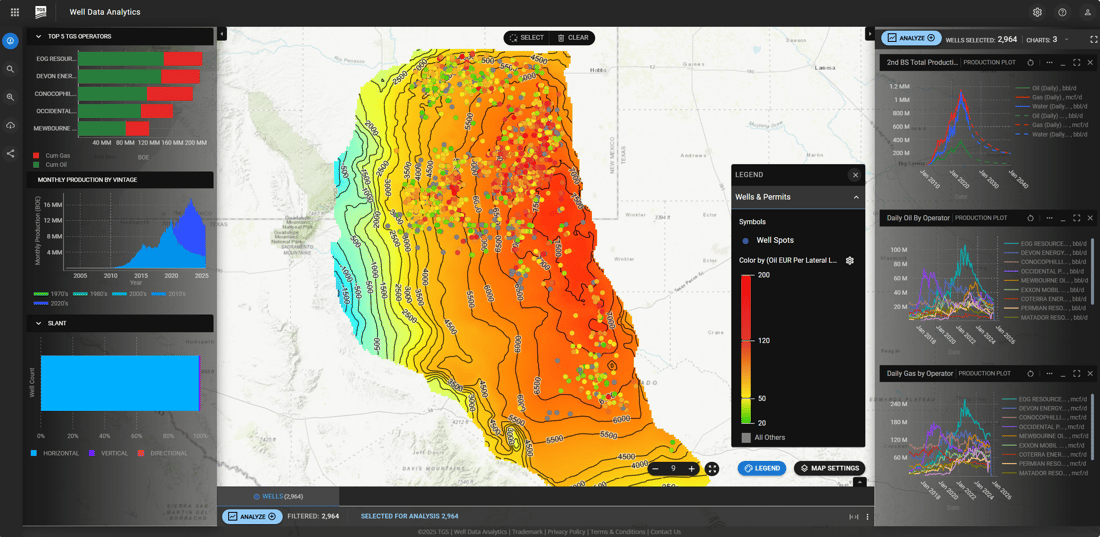
Figure 3. TGS Well Data Analytics dashboard displaying the 2nd Bone Spring wells colored by Oil EUR/PLL overlaying with 2nd Bone Spring Sand structure map and production plots.
Looking Ahead: Strategic Implications for 2025–2026
The 2nd Bone Spring remains a cornerstone of Delaware Basin development, but its future hinges on disciplined execution. The data point to three key takeaways:
- Core acreage is maturing fast
- Gas optionality is rising
- Geology still wins
For teams benchmarking acreage, forecasting inventory life, or planning multi-bench co-development, integrating these geological and performance insights will be essential to staying competitive in a more capital-disciplined era.
To explore available well data or schedule a demo, contact us at WDPSales@tgs.com and for more information about ComboCurve, click here.