

OSLO, Norway (26 March 2026) — Record offtake contract awards, large construction pipelines, impending investment decisions, and looming 2030 targets promise to make 2026 a defining year for offshore wind - according to the latest Global Market Overview report by wind market research and intelligence experts, TGS | 4C.
As a result, TGS | 4C analysts have maintained 2030 forecasts and slightly lowered 2040 forecasts. At the same time, the report notes that market conditions for offshore wind are improving on several fronts, going further into 2026.
Geopolitical developments, including the Iran conflict, could have a significant impact on the longer-term prospects for offshore wind as energy security is pushed to the top of political agendas.
Today’s report shows that the global offshore wind forecast for installed capacity in 2030 has fallen by 17% year on year, with expected capacity outside China reduced from 145 GW to 120 GW. Forecasts for 2030 have not changed since last quarter though, due to increased optimism following the UK’s Allocation Round 7, and the brief time horizon between now and 2030.
This analysis finds a 16% drop in 2040 expectations from Q1 2025 and a 25% drop from Q1 2024 expectations, indicating a prolonged downward correction for the industry. Meanwhile, 2026 shows signs of improvement, with many projects progressing to later stages of the pipeline, suggesting more stability ahead.
Offtake awards have seen a strong start, with a globally record-breaking Allocation Round 7 in the UK, which yielded 8.4 GW of contracts. This alone makes 2026 the fifth-largest year on record in Q1 and it could become the biggest year for offtake, with 19.6 GW, compared to 2024’s 19.1 GW.
Site awards in Q1 2026 have been slow, with only Norway’s Utsira Nord (1 GW) awarding so far this year. Activity is expected to increase significantly over the remainder of the year, with up to another 1.7 GW of floating projects and 17.4 GW of bottom-fixed projects expected. This is, however, down 79% from the peak in 2022.
With only 280 MW of projects reaching Commercial Operation Date (COD) so far this year, it has been a slow start. Despite this, we are expecting the second-largest volume of CODs on record at 17 GW, with 10.3 GW outside of China, taking globally installed capacity up to 103.4 GW by end-2026. While many contracts are coming to an end, the industry can find renewed hope with 15.9 GW of projects expected to make Final Investment Decision (FID) this year.
“With 2030 approaching rapidly, decisions taken this year by developers and governments alike will set the tone for the credibility of targets,” said Jordan May, senior analyst at TGS | 4C and lead author of the report. “Q1 has seen ambitious targets, such as the 100 GW Hamburg Agreement for 2050 and Scotland’s new 40 GW by 2040 target, but this year will test the old targets. Two and a half decades of credibility depend heavily on the next nine months.”
For the first time, this edition of the Global Market Overview includes an analysis of turbine failures. In addition, the report forecasts turbine failures to 2040. With more than 30,000 failures expected, around 50% of them in turbines under 10 MW, we see 44% of these occurring in Europe. A key underlying cause of turbine failure is component degradation, and the second largest cause is manufacturing, design, or installation issues. The conversation around grid security may focus on supply, but as components and industries mature, maintenance becomes a vital consideration.
“The Iran war and the resulting oil and gas supply reductions have reminded countries dependent on fossil fuel imports about their energy vulnerabilities,” said Ivar Slengesol, Managing Director and VP of TGS | 4C. “The offshore wind industry will be looking to see if a renewed focus on energy security will translate into political actions that accelerate site and offtake awards, permitting, and—ultimately—large-scale projects generating renewable energy.”
The Quarterly Market Overview Report is available exclusively to TGS | 4C subscribers, providing detailed forecasts, regional analysis and insights into policy, auctions and project pipelines across global offshore wind markets. This edition includes a deep dive into foundation concepts.
TGS | 4C provides intelligence reports on offshore energy trends via its 4C Intelligence platform. As a division of TGS, a leading energy data and intelligence provider, it also offers consultancy services for offshore projects, including offshore wind, subsea power cables, telecommunications, pipelines, and geospatial IT and GIS services. For further information, please visit www.tgs4.com (https://www.tgs4.com/).
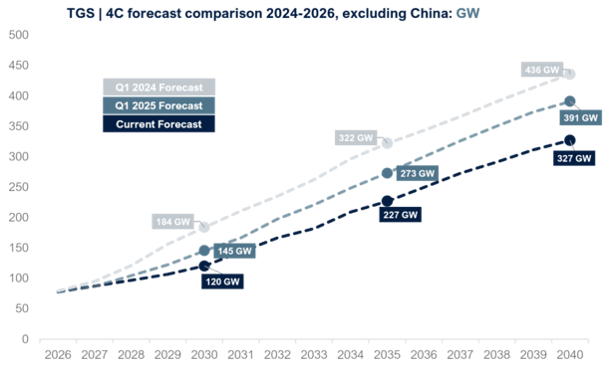
Image: Offshore wind capacity forecasts to 2035, illustrating successive revisions based on analysis from TGS | 4C.
About TGS
TGS provides advanced data and intelligence to companies active in the energy sector. With leading-edge technology and solutions spanning the entire energy value chain, TGS offers a comprehensive range of insights to help clients make better decisions. Our broad range of products and advanced data technologies, coupled with a global, extensive and diverse energy data library, make TGS a trusted partner in supporting the exploration and production of energy resources worldwide. For further information, please visit www.tgs.com (https://www.tgs.com/).
For media inquiries, contact:
Bård Stenberg
IR & Business Intelligence
investor@tgs.com