


Data-Driven Insights That Support the Companies’ AI-Enabled Development Strategy
Last week, Devon Energy and Coterra Energy announced an agreement to merge, creating one of the world’s premier large-cap shale operators with a footprint that spans multiple major U.S. basins, including the Anadarko, Eagle Ford, Marcellus, Rockies, and the Delaware Basin. Unlike many recent megamergers driven primarily by consolidation within a single core area, this transaction brings together complementary positions across several plays, giving the combined company broad opportunities to streamline development and capture efficiencies at scale. Still, the Delaware Basin stands out as the strategic anchor, expected to contribute more than half of total production (Figure 1). While the deal highlights scale and AI-enabled optimization, TGS Well Data Analytics (WDA) shows a notable operational contrast in the Delaware Basin: Devon has been significantly more active through 2025, with more than 500 new permits and over 200 wells brought online since January 2025, roughly three times Coterra’s recent permitting pace and double its new production starts. This difference in development tempo underscores how the merger combines not just acreage, but distinct operational strategies that could be optimized across the broader portfolio. Let’s take a look at differences in completion design and performance.
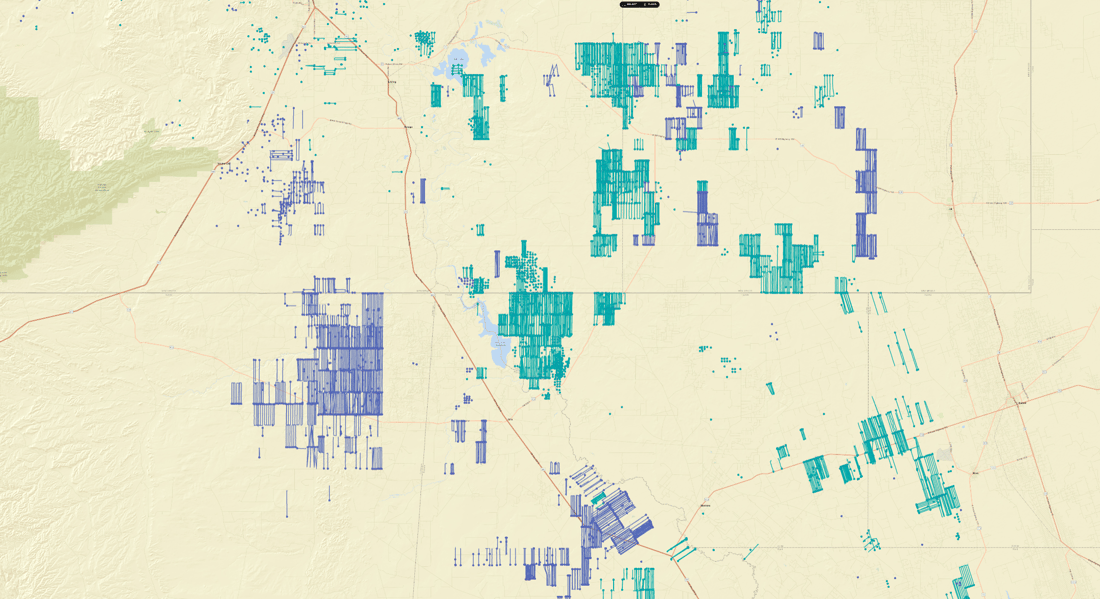
Figure 1. TGS Well Data Analytics dashboard displaying the coverage map for Devon (Teal color) and Coterra (Dark Blue) assets in Delaware Basin.
Completion design analysis using TGS data reveals clear philosophical differences between the two companies. Devon has generally drilled longer laterals, commonly in the 10,000–16,000 ft range and appears to be testing a broad spectrum of completion intensities, with proppant loading ranging from roughly 1,500 to 3,000 lbs/ft. Coterra’s program has been more standardized, clustering around ~2,500 lbs/ft (Figure 2). However, when correlating injected proppant per foot with EUR and BOE IP90, TGS analysis shows a stronger and more consistent positive performance relationship in Coterra’s wells than in Devon’s. This suggests that while Devon’s wider experimentation may support future optimization, Coterra’s more uniform completion strategy has already translated into clearer performance gains tied directly to proppant intensity.
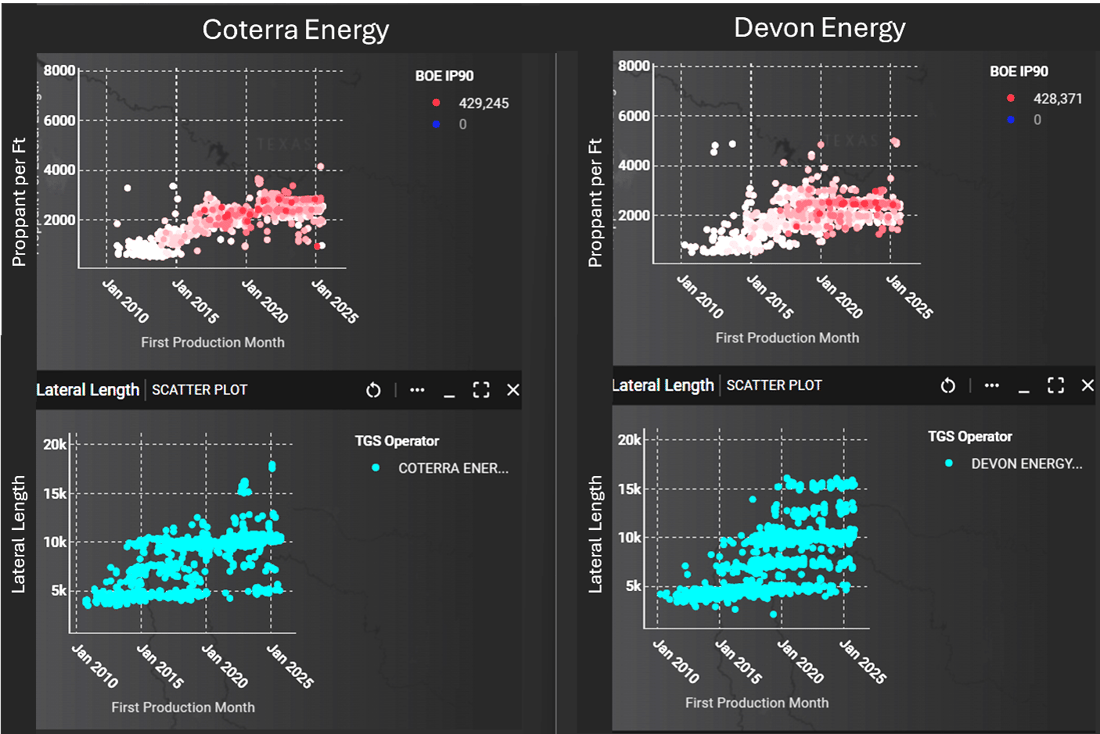
Figure 2. TGS Well Data Analytics dashboard displaying the comparison of completion design changes over time for both companies.
Landing zone insights add another layer of differentiation. Both operators are primarily targeting the Wolfcamp Shale, 2nd Bone Spring Ss, followed by Wolfcamp B and Wolfcamp Y. Yet TGS-derived production type curves indicate that Wolfcamp C, Y, and Shale deliver the strongest normalized performance among these intervals, outperforming both 2nd and 3rd Bone Springs. This finding suggests that precise bench targeting, not just completion intensity, could play a major role in enhancing well performance as development programs expand across the combined acreage position.
A detailed review of 74 Coterra-operated wells in Culberson County provides a localized example of how formation selection, completion design, and evolving well spacing strategies interact (Figure 3). The dataset spans multiple development generations. Early Wolfcamp C wells, completed in 2014–2015, were drilled on both the northern and southern portions of the pad with varying spacing, from approximately 2,500 ft in the north to 650 ft in the south, and lateral lengths between 5,000 and 7,500 ft as they tested development concepts in the interval. A subsequent phase in 2017 targeted Wolfcamp C again, this time with wider spacing near 850 ft and longer laterals approaching 10,000 ft. Following the success of a 10,000 ft Wolfcamp Shale well in 2021, development shifted toward Wolfcamp Shale and Wolfcamp Y, where infill programs were implemented at tighter spacing of roughly 500 ft. By 2023, the 3rd Bone Spring interval was brought into development using a similar lateral length and spacing design.
TGS data highlights how in-zone offset spacing has evolved over time as they moved from appraisal-style development to tighter, high-density infill programs. Across the newer Wolfcamp Shale, X, Y, and 3rd Bone Spring wells, typically completed with around 2,500 lbs/ft of proppant, breakeven prices are trending in the $35–$45 per Boe range, demonstrating how spacing optimization and modern completion intensity are working together to improve economic performance.
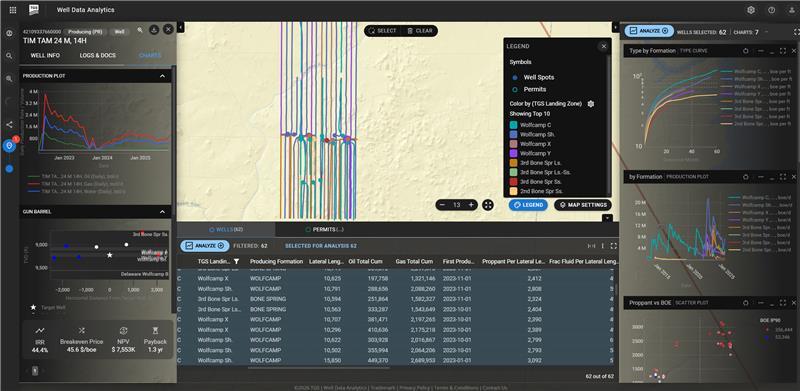
Figure 3. TGS Well Data Analytics dashboard displaying the Coterra wells in Culberson County, including type curve comparisons by formation and completions evaluation.
This type of basin-wide, data-driven analysis directly supports the companies’ stated strategy to expand the use of AI and integrated datasets to predict well performance before drilling, quantify the impact of geology and completion design, and optimize spacing and frac strategies. These kinds of interpretations depend on clean, well-structured, and contextualized data, a core focus of TGS, ensuring that advanced analytics and AI models are built on reliable, basin-wide datasets that can consistently inform better development decisions.
With TGS Well Data Analytics, this type of comparative analysis and benchmarking can be done in minutes. For more information about TGS Well Data Analytics or to schedule a demo, please contact us at WDPSales@tgs.com.