

US shale companies stand to realize significant upside from rapid price increases.
Over the past few weeks, commodity markets have experienced significant volatility, with the Brent crude oil benchmark nearly doubling from its Q4 average price per barrel due to supply disruptions from the ongoing Middle East conflict. While commodities analysts and the industry as a whole only expect a short-medium-term price increase, most are in agreement that the price spike is transitory versus structural. US shale companies are aligned with this view, sticking to their 2026 guidance and focusing on capturing upside from margin expansion as part of capital discipline strategy instead of trying to rapidly ramp up production. Further cementing this position taken by US shale companies is limited incremental gas takeaway capacity, especially pronounced in the Permian, which acts as a brake for increasing oil-directed drilling. In the EIA’s latest Short Term Energy Outlook (STEO), gas takeaway capacity constraints are expected to keep production relatively flat through 2026, projecting only a low single-digit percentage increase in oil production in 2027 because of elevated oil prices. However, even with relatively flat production, US shale operators will still be exposed to significant upside in 1-year free cash flow (FCF) generation, increasing by 24-34% across key Permian target zones for each $20 increase in oil price per barrel in a 3-month supply disruption scenario. This week, using TGS Well Economics within Well Data Analytics, we analyze how a short versus prolonged conflict affects free cash flow (FCF), net present value (NPV), and internal rate of return (IRR) under the corresponding price scenarios.
To determine the magnitude of the margin expansion from the rise in oil prices and its effect on FCF, NPV, and IRRs, performance of wells with 2-mile laterals with first production in 2025 were used as a proxy for Delaware Wolfcamp, Bone Spring, and Midland Wolfcamp-Spraberry landing zones in the Midland and Delaware Basins. By leveraging TGS Well Economics within Well Data Analytics, well-level FCF for each landing zone was compared across 3 different conflict duration scenarios of 3, 6, and 12 months and 4 different price deck scenarios of $80, $100, $120, and $150 per barrel against a base case of $60 per barrel. Within each scenario, gas price per mcf was held constant at a realized price of $1.50, determined by a combination of pre-conflict market and published realized prices in Permian operator earnings reports. Only 2-mile laterals were used in the analysis since nearly 50% of all horizontal wells drilled in 2025 across the Delaware and Midland basins reached a lateral length of 10,000 ft as the preferred well design across the region (Figure 1).
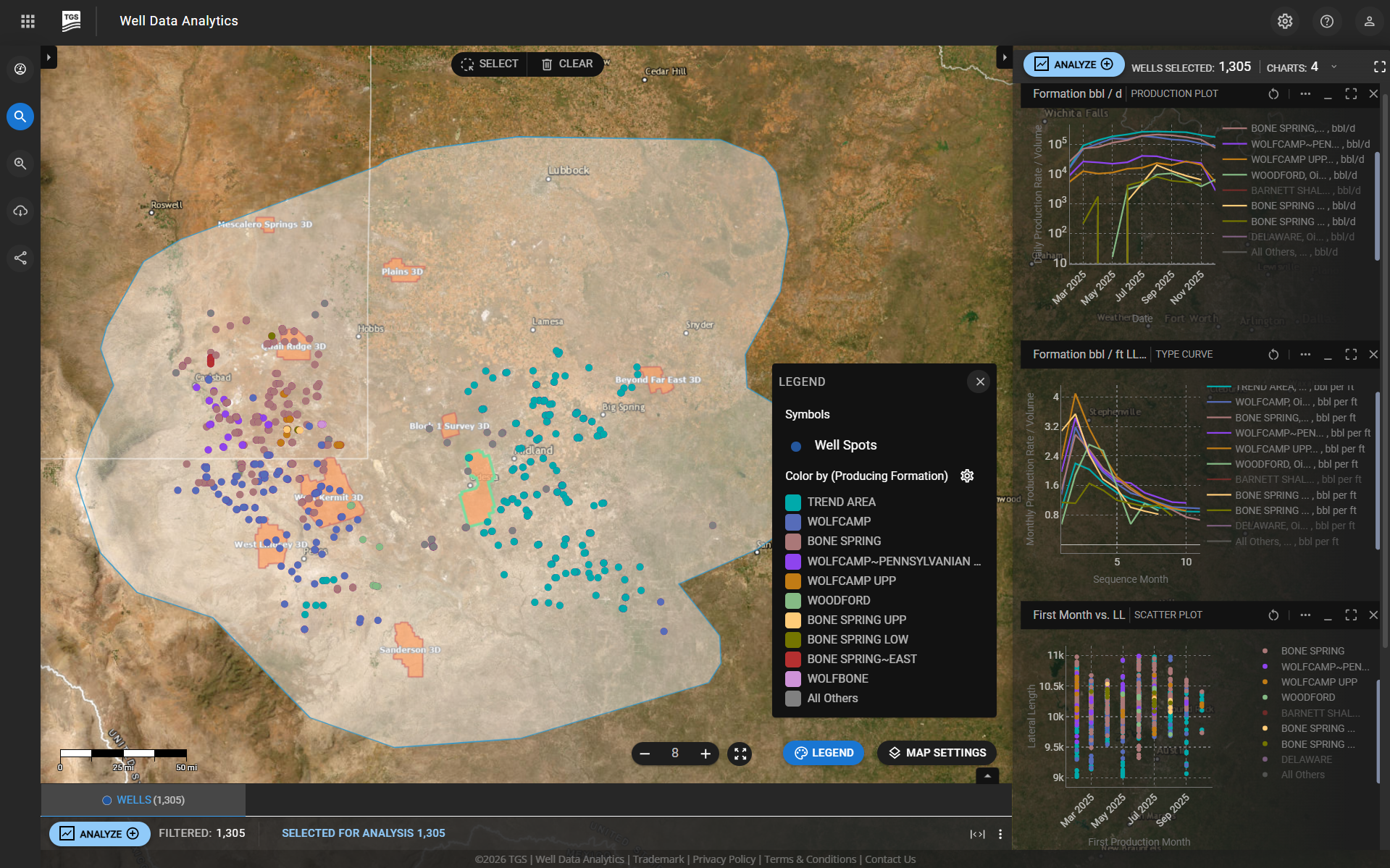 Figure 1. Well performance overview of horizontals with first production in 2025.
Comparing the 12 scenarios across each of the 3 formations, for each additional 3 months the supply disruption continues at the elevated price levels of $80, $100, $120, and $150, the 1-year FCF increases by 24%, 23%, and 29% for Bone Spring, Delaware Wolfcamp, and Midland Wolfcamp-Spraberry, respectively (Figure 2). Applying the majority analyst consensus of a shorter-range scenario of a 3-month price spike with $20 per barrel oil price increase from the base of $60 per barrel, a Permian operator could expect a 24-34% increase in FCF from new wells. At the higher end of analysts’ forecasts with $150 oil for the next 12 months, 1-year FCF per well would rise by 176-228% across the 3 primary target formations. In such a scenario, a Permian operator drilling 150 wells per year, split evenly across all three formations, could expect a 1-year average FCF increase of $1.5 billion. In either the short-term scenarios with relatively short-lived supply disruptions or longer-term scenarios with major disruptions, Permian operators stand to realize significant upside from the rapid appreciation in oil price.
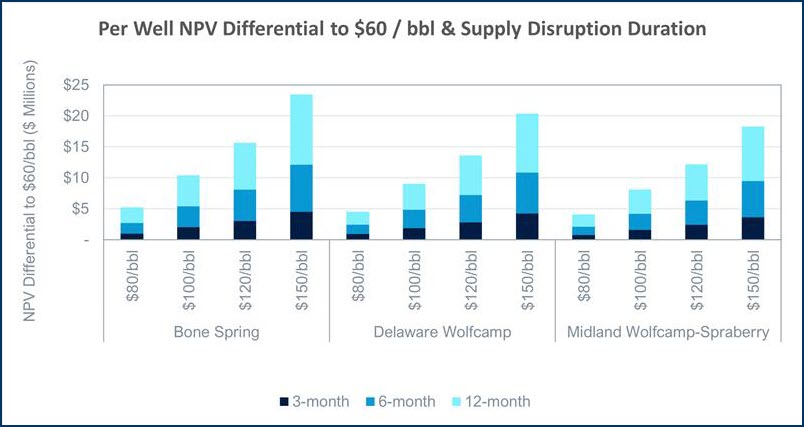 Figure 2. Individual well NPV change for each price and duration scenario.
For more information about TGS Well Data Analytics or to schedule a demo, please contact us at WDPSales@tgs.com.