


Using petrophysical logs and log-derived property volumes to understand halo plays and development expansion in the Powder River Basin.
In March 2025, the U.S. Geological Survey reported that significant undiscovered oil and gas resources remain across Wyoming’s basins, reinforcing that even long-produced areas like the Powder River Basin (PRB) retain meaningful subsurface potential when evaluated with updated geological frameworks. One example of this remaining potential is halo plays, areas adjacent to established production that were historically bypassed due to well-scale screening, consistent with the PRB “battleship” model of laterally continuous reservoirs which are unevenly penetrated. In Johnson and Campbell counties, Wyoming, development of these halo zones increased oil reserves in this field by 48.6 MMBO in post 2010 developed wells, illustrating how modern, regional workflows can materially change outcomes in basins long considered fully understood.
For decades, many U.S. sedimentary basins have been described as “mature,” implying that subsurface risk is largely understood and remaining opportunity is incremental. In the PRB, this perception has often been driven by legacy interpretations built from sparse well control, inconsistent petrophysical cutoffs, and asset-scale workflows that mask regional variability. The result is a structural view of prospectivity that underrepresents stratigraphic complexity and truncates reservoir extent. Re-evaluating the PRB using regionally consistent petrophysical logs and continuous log-derived property volumes offers a different outcome. Analysis of more than 4,300 core-calibrated petrophysical interpretation logs (Figure 1), integrated with stratigraphically constrained subsurface attribute volumes, reveals laterally continuous reservoir trends and subtle changes in reservoir quality that were not resolved in earlier models.
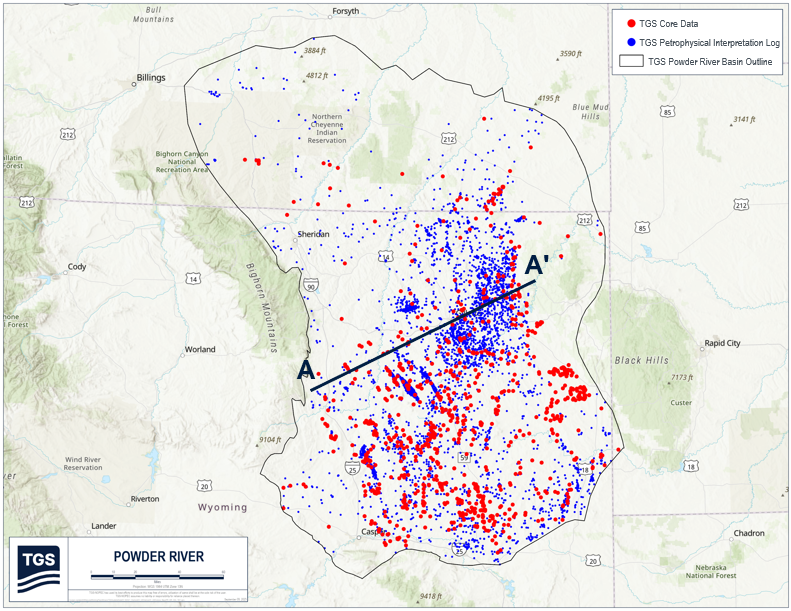
Figure 1. Spatial distribution of TGS Petrophysical Interpretation (PI) Logs (blue) across the Powder River Basin, shown alongside associated TGS Core Data (red) used for calibration. The broad geographic coverage and integration of core-calibrated petrophysics provide a consistent, basin-scale foundation for evaluating stratigraphic and reservoir variability beyond individual fields or operators. Cross-section A–A' is in Figure 3.
Formation-level maps of net reservoir thickness, net-to-gross, and effective porosity show systematic changes in reservoir quality that align more closely with stratigraphic position than with structure alone. Across the Mowry, Shannon, Frontier (Wall Creek–Turner), and Muddy formations, these properties vary laterally in ways that extend beyond traditional development fairways (Figure 2), variability that was commonly averaged out in legacy interpretations. Cross-sections (Figure 3) further illustrate that vertical stacking patterns and depositional architecture exert strong controls on reservoir quality, reinforcing the importance of stratigraphic context over field-by-field evaluation. Similar reinterpretations are occurring in other long-produced U.S. basins, suggesting this approach reflects an industry-wide shift rather than a basin-specific anomaly.
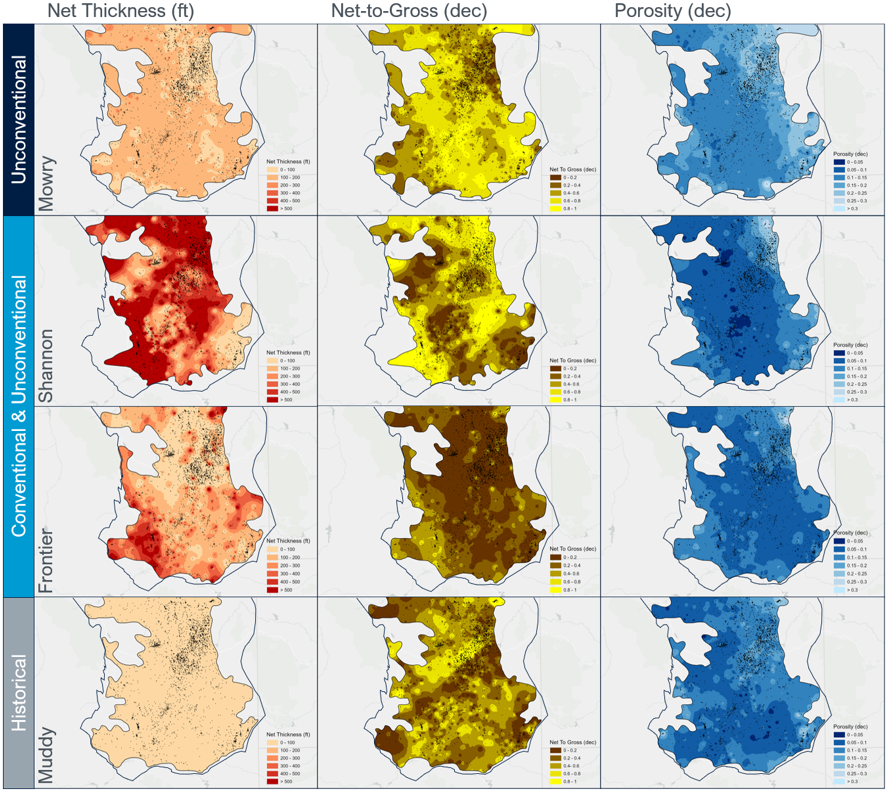 Figure 2. Formation-level maps (Wyoming Powder River Basin) from the Mowry, Shannon, Frontier (Wall Creek–Turner), and Muddy formations. Maps of net reservoir thickness, net-to-gross, and effective porosity are derived from the TGS PI Log dataset.
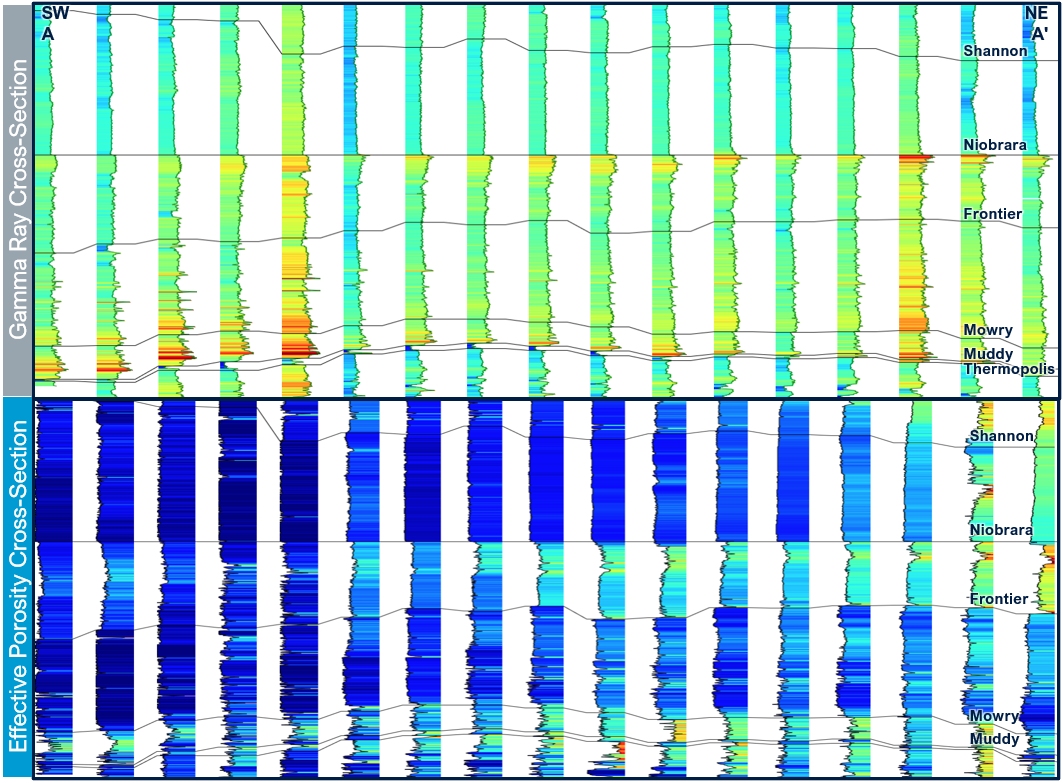 Figure 3. Representative cross-section through the Powder River Basin flattened on the Niobrara showing formation tops alongside log responses (gamma ray [scale: 0–225 API] and effective porosity logs [scale: 0–.35 dec]). Variations in petrophysical character align with stratigraphic position and vertical stacking patterns, illustrating how depositional architecture contributes to reservoir heterogeneity beyond structural control alone. Map location can be found in Figure 1.
One practical outcome of this improved understanding is the recognition of halo intervals adjacent to historically developed reservoirs. These fringe zones were often screened out by well-scale petrophysical cutoffs in conventional development, yet regional log attributes and core-calibrated petrophysics demonstrate that they are stratigraphically consistent and laterally continuous, making them amenable to unconventional development techniques. Well-level production trends indicate that operators are already expanding development into these areas (Figure 4), with halo intervals contributing incrementally when evaluated within a modern stratigraphic framework. Wells developed post 2010 in this halo field (Johnson and Campbell counties, Wyoming), increased oil reserves by 48.6 MMBO (Figure 4). This is not a new play or a claim of outperformance, but a clearer definition of reservoir extent enabled by better data integration, improved drilling technology, and more consistent interpretation.
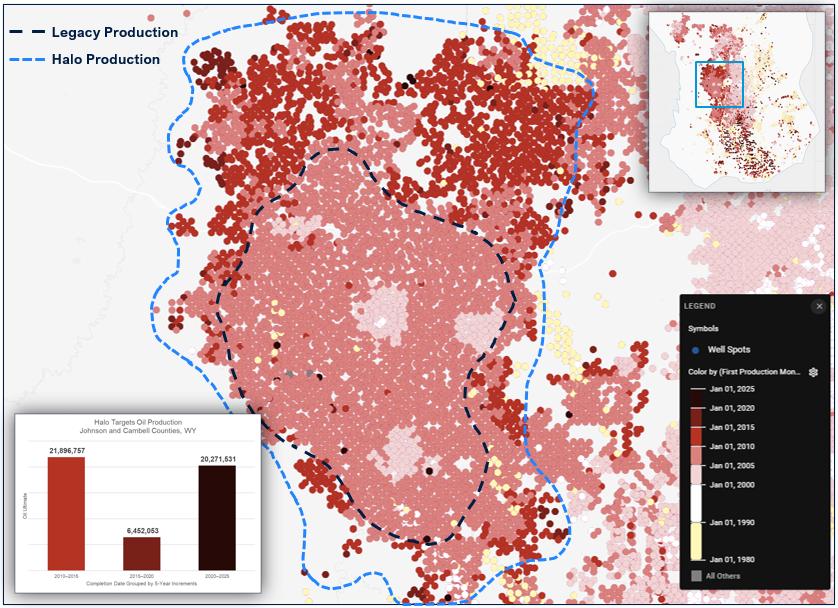 Figure 4. Well spot map colored by first production, illustrating development patterns expanding outward from historically targeted reservoir intervals (black dashed line) into adjacent halo zones (blue dashed line). When evaluated within a modern stratigraphic and petrophysical framework, these fringe intervals show consistent characteristics and meaningful production contribution, expanding the interpreted extent of the reservoir without redefining the play concept. Map generated using TGS Well Data Analytics.
The PRB illustrates how modern regional datasets can reshape subsurface understanding in areas long considered fully developed. By revisiting familiar basins with calibrated petrophysical libraries, continuous subsurface attributes, and integrated interpretation workflows, geoscientists are uncovering variability that was always present but previously unresolved. As teams move into 2026, competitive advantage may increasingly come not from frontier exploration, but from telling new stories with old basins, using modern data to reduce uncertainty, refine development decisions, and extend the productive life of mature assets.
For more information about TGS Geological Data, TGS Well Data Analytics or to schedule a demo, please contact us at WDPSales@tgs.com.